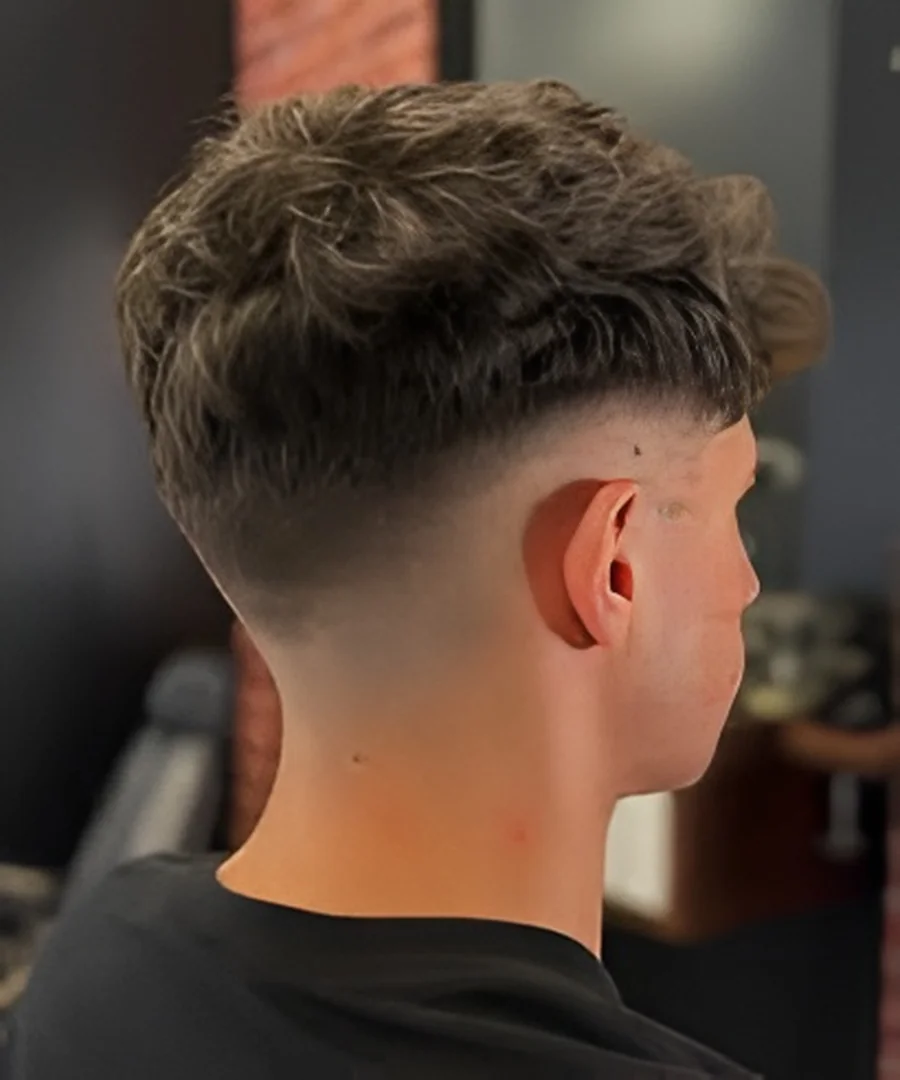
Mid Drop Fade Fringe
Styling Guide
A mid drop fade fringe pairs a curved fade on the sides with hair left long on top and swept forward over the brow — the opposite styling direction of a quiff or pompadour.

Mid Drop Fade Fringe Pairing
A mid drop fade fringe sends the top in a completely different direction than a quiff or pompadour. Instead of building height by sweeping hair up and back, the fringe is left long enough to fall forward, settling just above or even across the brow. The fade still does its usual job on the sides, curving down behind the ear, but the overall effect is softer and more casual than the structured, upright styles.
This is one of the lowest-maintenance pairings on the list day to day, since a fringe mostly just needs to be left alone or lightly tousled rather than dried and shaped against gravity. The trade-off is that it needs more frequent attention from the length itself — a fringe that's grown too long starts covering the eyes and losing its shape, so it can't stretch as far between trims as a shorter style might.
Texture plays a big role in how this looks. Straight hair gives a sleek, controlled fringe that can look almost geometric when cut with a sharp, straight edge. Wavy or curly hair breaks the fringe up into a messier, more textured shape, which tends to look more relaxed and less deliberate — both are popular, it's really down to preference and how the rest of the haircut is styled.
Face shape is also worth considering with a fringe. A full fringe sitting low on the forehead tends to shorten the appearance of a longer face, while a side-swept or slightly shorter fringe works better on a rounder face, since it avoids adding extra width near the eyebrows.
Styling & maintenance tips
- 1Dry the fringe downward and forward, not up. Pointing the dryer down while combing the fringe forward sets the direction it'll naturally fall throughout the day.
- 2Use a light cream or matte paste, not a heavy pomade. The fringe needs some texture and separation, not a stiff, glued-down finish.
- 3Trim the fringe length every 3 to 4 weeks. This grows out faster than the rest of the cut and needs its own attention even between full fade touch-ups.
- 4Keep the fade on a normal 2 to 3 week schedule. The sides still need the same upkeep as any other mid drop fade, even though the top is styled differently.
- 5If it's getting in your eyes, it's time for a trim. A fringe that interferes with vision has grown past the point where styling alone can fix it.
Mid drop fade fringe gallery