Mid Drop Fade
Long Face
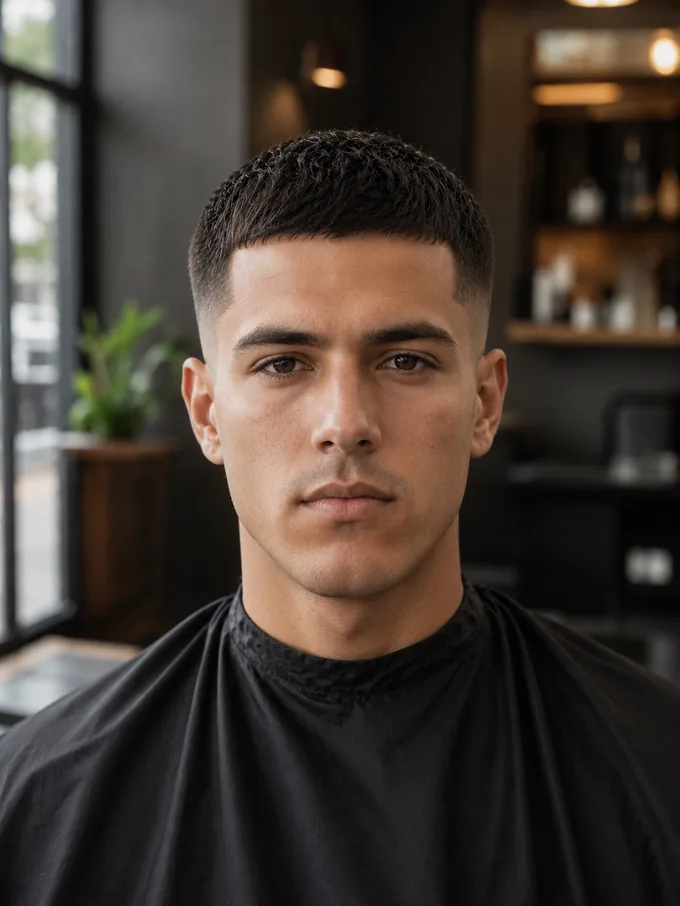
A mid drop fade long face pairing has one rule above all others: no height on top. Everything else follows from that.
Why it
works
A long face — sometimes called oblong or rectangular — is noticeably taller than it is wide, usually with a high forehead, straight sides, and forehead, cheekbones and jaw all fairly similar in width.
Barbers will tell you this is the shape that gets mismatched most often, and the reason is simple: men ask for height. Tall quiffs and pompadours dominate trend lists, so that's what gets requested. On a long face, height at the crown adds to the one dimension that's already generous.
A mid drop fade long face pairing works when you flip that instinct. The drop sits lower, closer to a low drop fade, so weight stays at the sides where it frames the face horizontally. The top stays under two to three inches and gets styled forward or across, never up. That's the whole strategy — reduce vertical, add horizontal.
Compare that to a round face, which wants the drop raised and height added on top. Same haircut, opposite instructions.
Long, oblong, or just oval?
Long and oval get mixed up constantly, and it matters here, because an oval face can carry the height a long face can't. Pull your hair back and check:
- Measure roughly from hairline to chin, then across the cheekbones.
- Compare forehead, cheekbone and jaw widths to each other.
- Look at the sides of your face — straight, or curved?
Then do the maths: divide the length by the width. That single number is the most useful thing you can know here. Around 1.5 or above is oblong territory. Roughly 1.45 is the boundary with oval. The higher the number, the more horizontal correction the cut needs — someone at 1.7 should be stricter about every rule on this page than someone at 1.5.
If the ratio is high, the three widths are all similar, and the sides run fairly straight rather than curving, that's a long or oblong face and this guide applies. A high forehead makes it more likely still.
If the length is only moderately greater and the jaw is narrower than the cheekbones, you're closer to oval, which is far more forgiving. If the jaw has visible corners and the face is long, that's rectangle — treat it as long, but see the square face guide for how to handle the angular jaw.
Three rules that decide everything
Cap the top at 2–3 inches
Styled length, not wet length. Past that, the silhouette starts adding to the face's height no matter how you wear it. Under it, you still have enough to sweep.
Keep the fade low, not tight
A low or mid drop preserves bulk above the ears, which frames the face horizontally. A skin fade strips that away and narrows the whole silhouette.
Style across, never up
Forward, side-swept, or softly back. Any direction that moves hair horizontally works. Anything lifting it vertically off the forehead works against you.
One refinement worth asking for: a taper rather than a fade. A taper reduces length gradually toward the ears without a hard contrast line, which leaves noticeably more bulk at the sides than any fade does. For a high length-to-width ratio, that extra width is worth more than the sharper look of a defined fade.
Recommended variations
The strongest option. A fringe covering one to two inches of forehead cuts the face's visible length more than any other single change.
The part creates a strong diagonal that pulls the eye sideways, and the sweep adds width across the forehead.
The pattern runs horizontally across the head, which is exactly the direction a long face benefits from, with no styling height involved.
Cuts that already follow these rules
Every barber recognises these by name, and each one is built around a forward or horizontal top with short-but-not-stripped sides. Naming one is often faster than describing the effect you want:
French crop — short textured top with a blunt fringe combed forward. The most direct answer to a long face, and currently the most requested of the four.
Caesar cut — a horizontal fringe cut straight across, usually just above the brows. Shorter and blunter than the French crop, with the same shortening effect.
Ivy League — a slightly longer crew cut with enough length to take a side part. Minimal bulk, but the styling direction does the work. Professional, and it suits any age.
Side quiff — volume swept toward the temple instead of upward. Gives you the shape of a quiff without the height penalty.
One thing outside the haircut that's worth knowing: wide or browline glasses frames add a strong horizontal line across the middle of the face. If you wear glasses, the frame shape does as much for your proportions as the cut does.
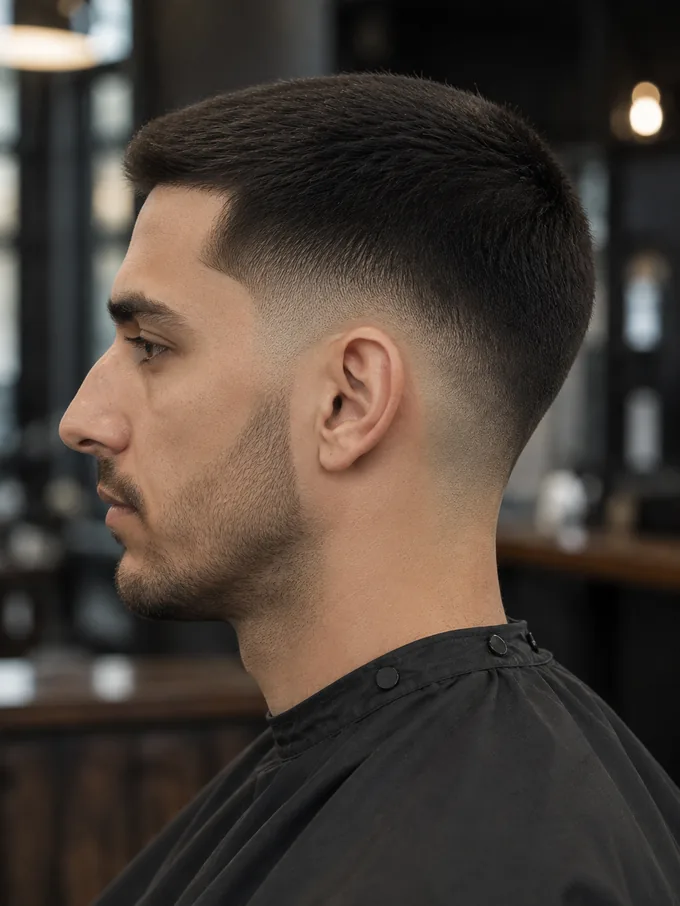
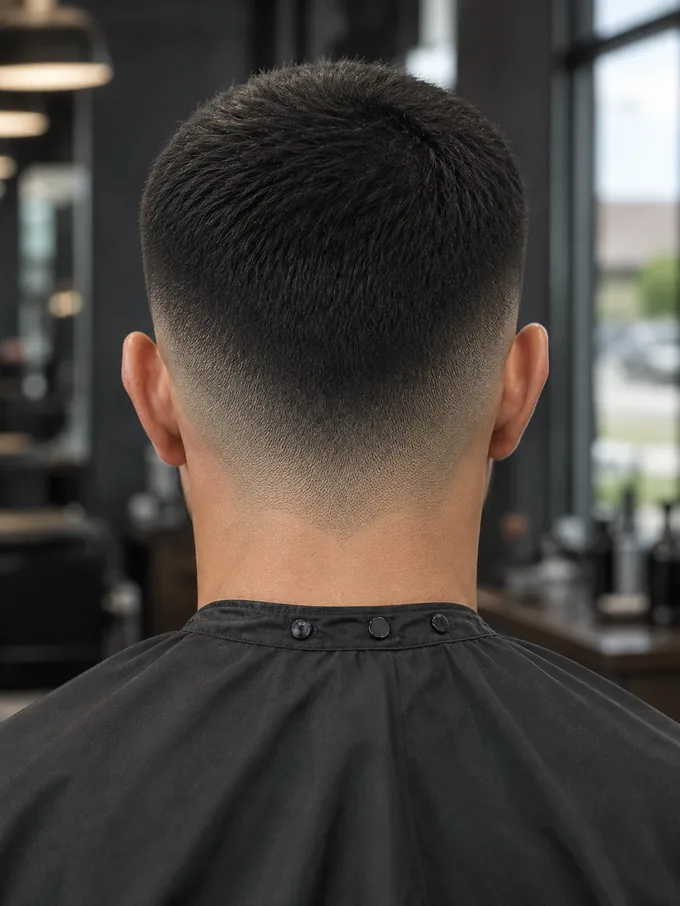
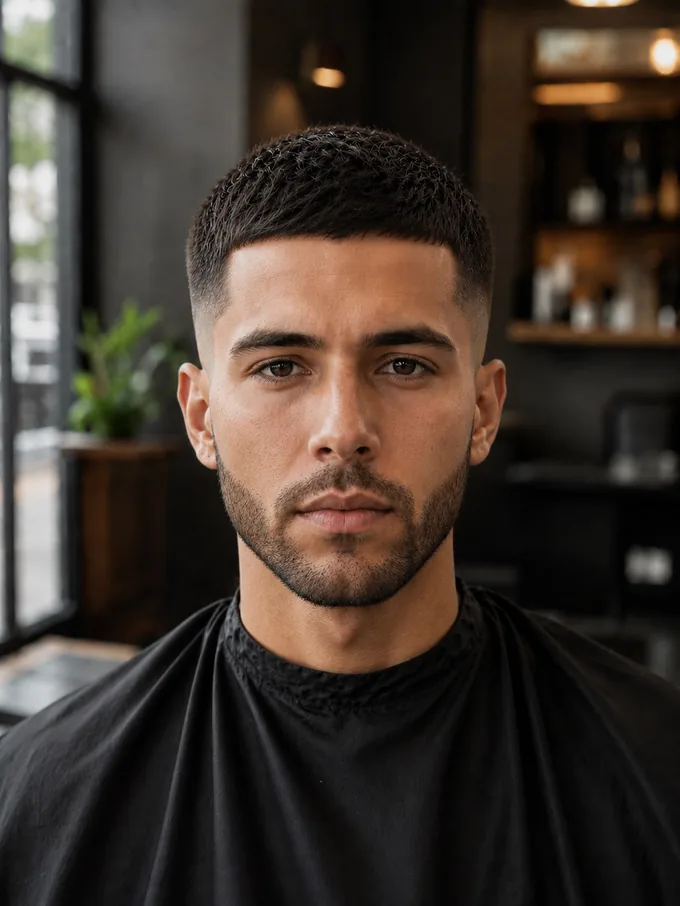
Mid drop fade long face gallery
What to say to your barber
Barbers respond to three inputs: top length, fade height, and styling direction. Give all three plus your face shape, and most will adjust instinctively. Pick whichever matches the style you want:
Textured crop with forward fringe
"Textured crop, choppy on top, low to mid drop fade. I want the fringe sitting forward — I've got a long face so I'm trying to avoid height."
Low side part
"Medium side part, about two to three inches on top. Side-swept, not back. Low drop fade — I want to keep the width on the sides."
Blunt fringe / Caesar
"Blunt fringe just above the eyebrows, straight across rather than swept. Sides slightly fuller than a standard crop, with the drop kept low."
If you say nothing else, say this
"Keep the top controlled rather than tall, and leave enough side structure that my face doesn't look narrow."
Bring a reference photo alongside the words. Length and fade height are the two things most often misread from a verbal description alone. Our full barber communication guide covers the rest.
Matching it to your hair type
| Hair type | What works | What to watch |
|---|---|---|
| Fine, straight | A blunt fringe adds the density illusion fine hair lacks. Matte clay or texturising powder for grip without weight. | Heavy gel or pomade. It flattens fine hair against the skull and makes the silhouette narrower, which lengthens the face. |
| Thick, straight | Almost any of the three recommended styles. Density gives you real horizontal volume at the sides. | Bulk piling up on top rather than at the sides. Ask for weight removed through the crown specifically. |
| Wavy | The best hair type for this face shape. Wave naturally spreads outward, adding width with no styling effort. | Letting it grow long enough to hang down. Length past three inches pulls the whole shape vertical again. |
| Curly | Curl volume at the sides is an advantage. Keep the shape rounded and wide rather than tall. | Height building at the crown as curls grow up rather than out. Regular shaping matters more here than elsewhere. |
How to shape the beard
A beard helps a long face, but only the right shape. This is the one place where the usual "longer beard, stronger jaw" advice actively backfires.
Keep it short at the chin, fuller at the cheeks. Length hanging below the jaw extends the face downward and undoes everything the haircut is doing. Width at cheek level does the opposite, adding horizontal bulk exactly where you want it.
Square the bottom, don't point it. A pointed or goateed shape draws the eye down to a single point and stretches the silhouette. A flat, squared-off finish keeps it compact.
Set the cheek line high and leave it wide. Don't taper the sides in tight. The wider the beard sits across the cheeks, the shorter the face reads. See the beard pairing guide for how the drop line connects into the beard fade.
What to avoid
- Tall pompadours and vertical quiffs. The single biggest mistake, and the most-requested style in barbershops. Height at the crown adds directly to a face that's already long. Note the word vertical — a side quiff, swept toward the temple rather than up, is one of the better options for this shape.
- High fades and skin fades. Both strip width from the sides. Below the ears is where a long face needs horizontal framing most, and a tight fade removes it.
- Slicked-back styles. Pulling everything up and away exposes the full height of the forehead, which on a long face is usually the tallest part.
- Mohawks and faux hawks. Narrow sides plus vertical volume is the worst possible combination for this shape.
- Letting the top grow past three inches. Even styled forward, extra length eventually drags the silhouette vertical.
- A long or pointed beard. It extends the face downward. Short and wide is the direction here.
- Heavy gels. They flatten hair to the skull, narrowing the silhouette and stretching the face.
Common mistakes
Copying a trending style without checking the proportions. Most viral men's cuts pair long tops with very short sides. That combination is close to the worst case for a long face, no matter how good it looks on someone else.
Asking for a "mid drop fade" and nothing more. The barber's default drop height will usually be higher than a long face wants. The drop height is adjustable, but only if you ask.
Going too short on the sides to look neat. Tidy and tight aren't the same thing. A clean low fade with weight left above the ears reads just as sharp and does far more for your proportions.
Stretching the trim schedule. Every 4 to 6 weeks. When the top outgrows its length and the sides lose their shape at the same time, the balance the cut was built on disappears fast.
Not photographing it after the cut. Ask the barber to style it, then take a photo. Forward-swept and side-swept styles are easy to get wrong at home, and a reference removes the guesswork.
Myths vs facts
Myth: Height on top makes any face look sharper.
Fact: It suits round and square faces. On a long face it adds to the dimension that's already dominant, which is why barbers say this is the shape that gets mismatched most.
Myth: Tighter sides always look cleaner.
Fact: A skin fade removes the side width that frames a long face horizontally. A low fade with some weight left looks equally sharp and balances better.
Myth: A fringe is a young man's style.
Fact: A short, textured forward fringe is one of the most effective adjustments available for this face shape at any age, and a French crop or Caesar reads as classic rather than youthful.
Myth: A full beard adds structure, so longer is better.
Fact: Length below the jaw extends the face downward. Short and wide at the cheeks is what helps a long face; long and pointed makes it worse.
Pros and cons for long faces
Pros
- The drop height is adjustable, so the same cut tunes lower for this shape
- Low styling effort — no lifting, blow-drying, or holding height in place
- Works especially well with wavy and curly hair, which add width naturally
- Forward-fringe styles age well and hold shape between trims
Cons
- Most trending styles are the wrong direction for this shape
- Needs an explicit brief, since barbers default to a higher drop and tighter sides
- Top length has a hard ceiling around three inches
- Loses balance quickly when overgrown, so 4 to 6 week trims matter
Is this the right version for you?
Good fit if: your face is clearly longer than it is wide, you're happy keeping the top under three inches, and you want a cut that needs almost no daily styling.
Reconsider if: you specifically want a tall, structured style — that's working against the shape, and an oval face carries it far better.
Not sure of your shape? Check the measurements again above, or try the fade finder quiz.