Mid Drop Fade
for Oval Face
A mid drop fade oval face pairing has the most flexibility of any shape — here's how to make the most of that.

Is your
face really
oval?
Before assuming this mid drop fade oval face guide applies to you, it's worth a quick check. Stand in front of a mirror, pull your hair straight back, and trace the outline of your face with a finger or a washable marker. An oval face is typically about one and a half times longer than it is wide, with a gently rounded jawline that's narrower than the cheekbones, and a forehead roughly the same width as the jaw.
If your reflection is noticeably wider relative to its length, you may be looking at a round or square face instead, and those pages will give you more accurate guidance. If the jaw comes to more of a point, heart-shaped is worth checking too. If the face is clearly longer than one and a half times its width, check the long face guide, since adding height is the one thing you'd want to avoid there.
Why it
works
An oval face has no extreme proportion that needs counterbalancing. It isn't too wide, too narrow, or too angular, which is exactly why it's considered the most versatile face shape for haircuts in general.
With a mid drop fade oval face pairing specifically, that means the drop point isn't doing corrective work the way it is for rounder or squarer faces. You can run it higher for more contrast and a sharper look, or lower for something subtler, and both read as intentional rather than compensating for anything.
The practical upside is that a barber has no specific height they need to hit for the cut to look right, which makes an oval face one of the easiest to cut a mid drop fade on. The practical risk is the opposite one: with no constraint pushing you in a direction, it's easy to overdo the top or the sides and disrupt a balance that was already working.
Choosing your drop height
Since an oval face isn't dictating the drop height, let the top length decide it instead. That's the rule barbers actually work to:
Tall or voluminous top? Keep the drop mid or low. A high drop plus a lot of height stacks contrast on contrast and starts to elongate a face that was already balanced.
Short or moderate top? A higher drop gives the cut definition it would otherwise lack, and there's nothing on an oval face that pushes back against it.
Thick or wavy hair? Ask for internal texture through the top so it doesn't puff out and add width by the end of the day.
Still deciding? Try the fade finder quiz for a recommendation based on your hair type too.
Recommended variations
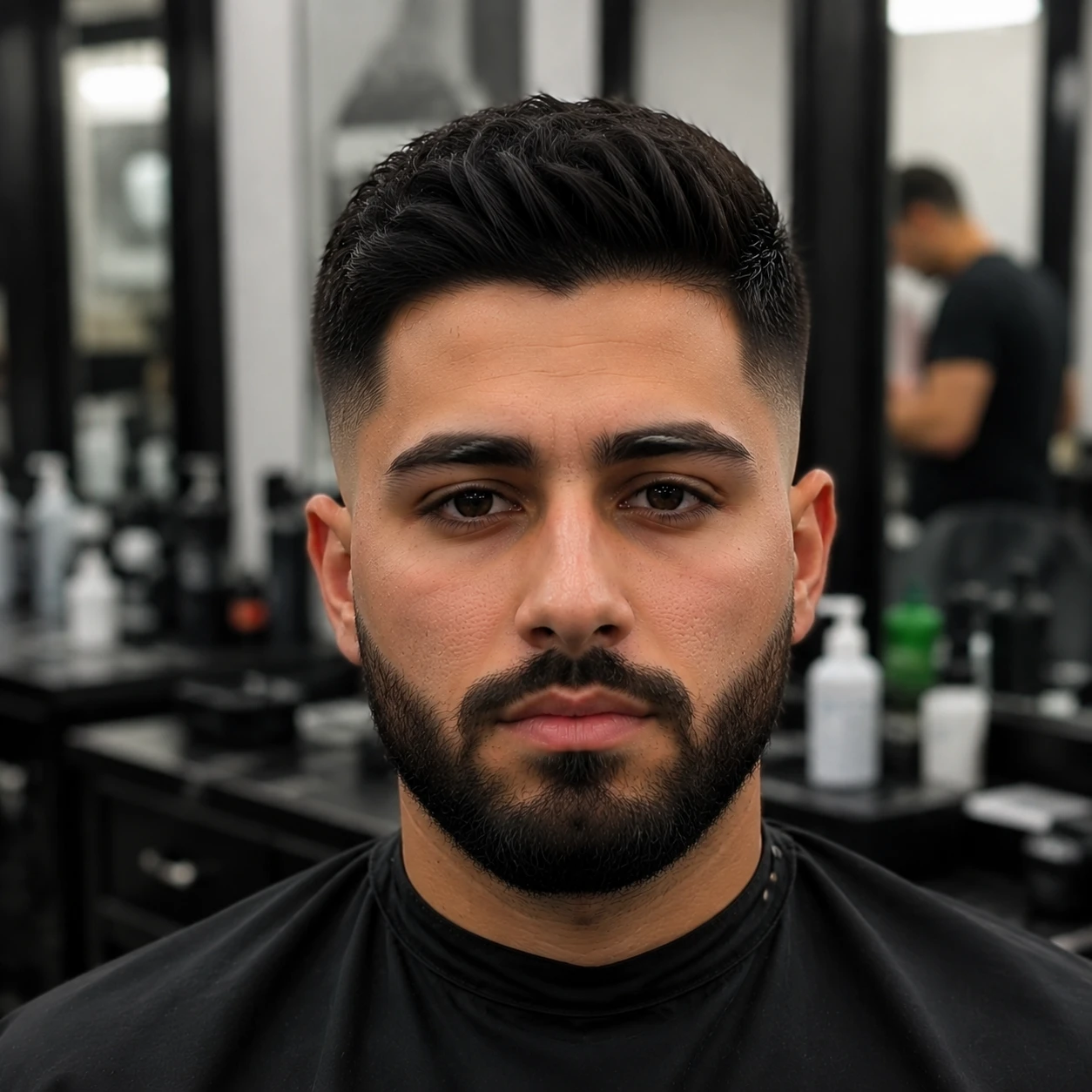
A classic, structured top that takes full advantage of an oval face's balanced proportions. Keep the height moderate rather than towering.
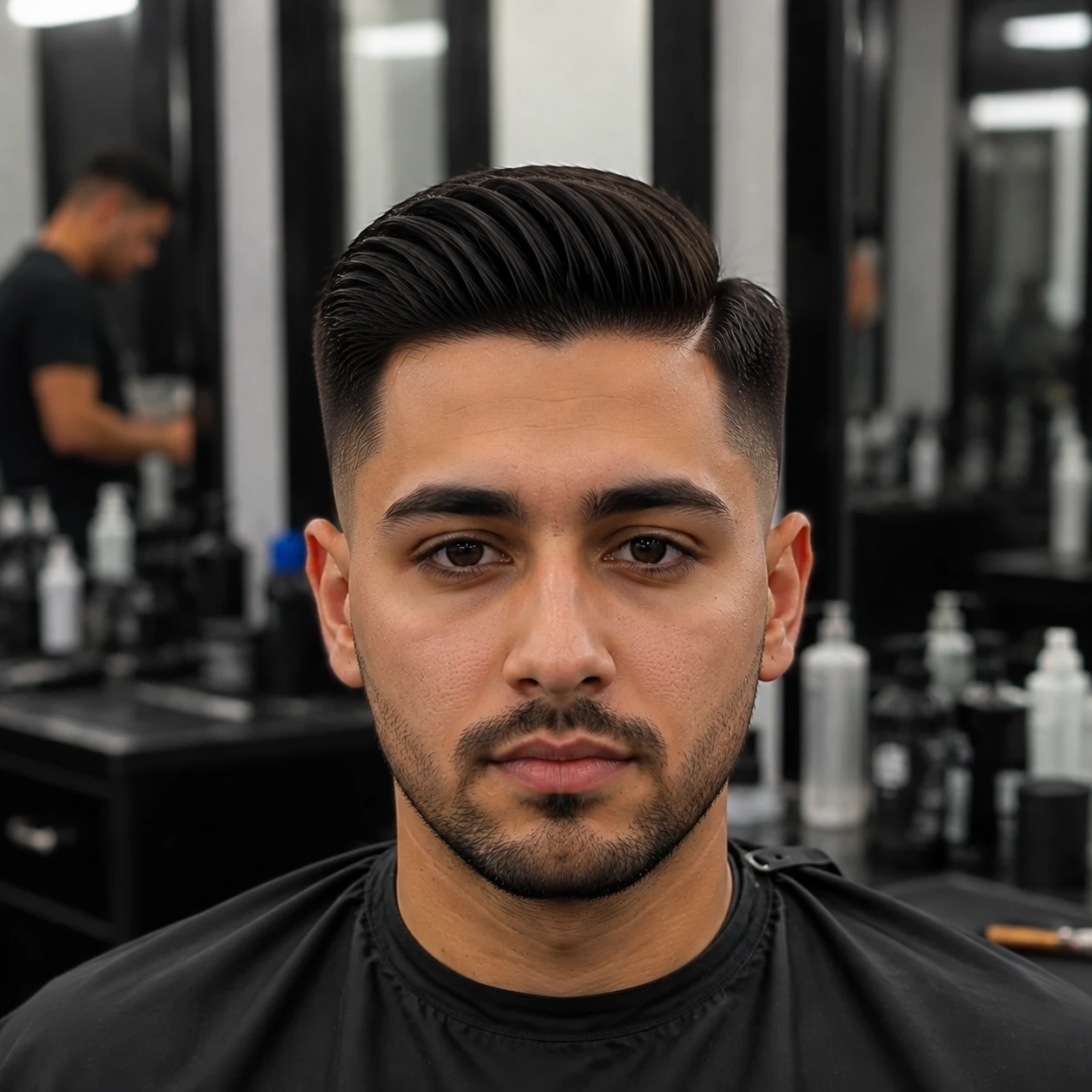
A sharp side-swept comb-over reads especially clean against an oval's even jawline, and it's the most repeatable of the three.
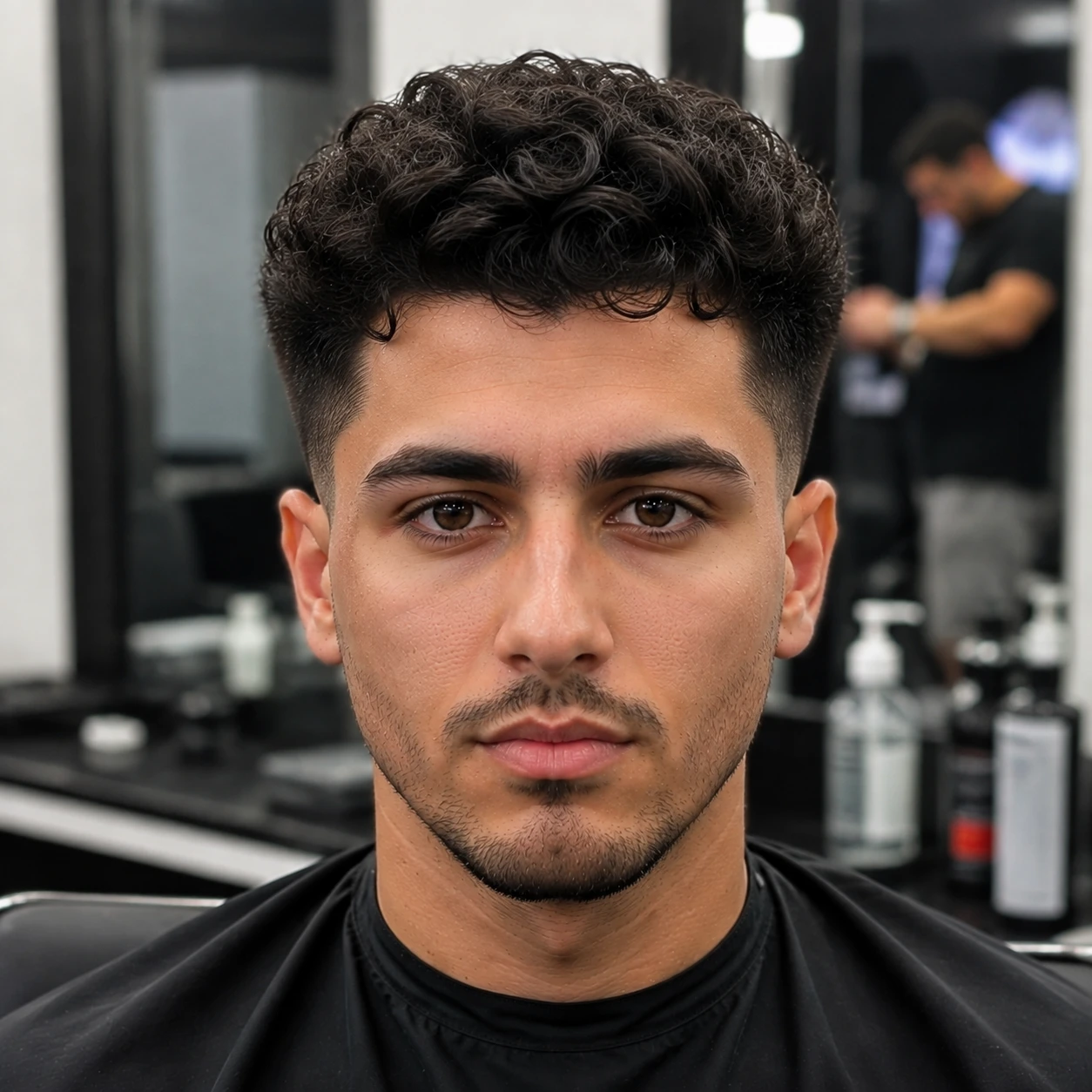
Natural curl texture on top has no width to fight against, so it sits easily on an oval shape with minimal product.
Mid drop fade oval face gallery
Matching it to your hair type
| Hair type | What works | What to watch |
|---|---|---|
| Fine, straight | Shorter, textured tops. A blunt fringe or textured crop creates the illusion of density the hair doesn't have on its own. | Long styles expose thinness, and a pompadour rarely holds without heavy product that ends up looking greasy. |
| Thick, straight | Almost everything. This is the most flexible combination there is: pompadour, slick back, comb-over, textured crop. | Bulk building up above the ears between cuts. Ask for weight removed through the sides, not just length. |
| Wavy | Medium-length tops that let the wave carry the shape without much daily styling. | Puffing out by afternoon. Internal texture through the top is what stops the width creeping in. |
| Curly | Working with the curl pattern rather than against it. Clean edges, natural volume left on top. | Cutting curls to a uniform length, which flattens the pattern. Ask for shape, not just shortening. |
What to avoid
- A very tall pompadour over shaved sides. The single most common oval-face mistake. Extreme height plus stark side contrast stretches a face that was already well-proportioned.
- A centre part with long, flat hair. It splits the head symmetrically and drags the shape downward, removing the structure the fade is meant to create.
- Micro fringes and ultra-tight buzz cuts. Both strip away the shape on top entirely, leaving the fade doing all the work with nothing to balance against.
- Copying a style meant to correct a different shape. Cuts built to add width or length for other face shapes can look unnecessary on a face that's already balanced.
- Assuming flexible means no thought required. Barbers still need to know your hair type and density to blend the drop cleanly, whatever your face shape.
Common mistakes
Treating "it all works" as "it doesn't matter what I choose." Just because an oval face doesn't need correcting doesn't mean every drop height or top style looks equally good. Hair type and how much styling time you'll actually put in still guide the best result.
Bringing a reference photo from a very different face shape. A style chosen to fix a round or square jaw can look over-styled on a face that never needed the correction. Bring references from other oval-shaped examples where you can.
Describing the style by name instead of by proportion. Names mean different things in different shops. Saying "I want volume on top and a clean, structured shape" gets you closer than naming a cut and hoping the barber pictures the same thing. Our barber communication guide covers the exact wording.
Letting it grow out too long between visits. Balanced cuts lose their shape faster than corrective ones, because there's no strong silhouette holding the look together once the blend softens. Every 3 to 4 weeks keeps it reading as intentional.
Myths vs facts
Myth: An oval face can pull off literally any haircut with zero thought.
Fact: It has more flexibility than other face shapes, but hair type, density, and personal style still matter for the best result.
Myth: A higher drop always looks better since it adds contrast.
Fact: On an oval face, the right drop height depends on the top. A tall top pairs better with a mid or low drop, while a shorter top can take a higher one.
Myth: Since nothing needs correcting, there's nothing to avoid.
Fact: There are a few genuine misfires, mainly extreme height over shaved sides, and flat centre-parted length. Both disrupt a balance that was working.
Myth: A beard is necessary to finish the look properly.
Fact: A beard adds some definition, but it's optional rather than corrective on an oval face, unlike on some other face shapes.
Pros and cons for oval faces
Pros
- Works at almost any drop height, high or low
- No specific correction needed, so styling is flexible
- Pairs well with a wide range of top styles
- Easier for a barber to get right first time, since there's no exact height to hit
Cons
- Too much flexibility can lead to indecision without a clear style preference in mind
- Styles built to correct other face shapes can look unnecessary here
- Loses its shape faster when overgrown, since no strong silhouette holds it together
- Still requires a proper consultation despite the shape being forgiving