Mid Drop Fade Cost
& Price Guide
A mid drop fade cost sits around $35–50 in the US and £18–30 in the UK in 2026. Here's the full breakdown, including what it actually costs you per year.
What you'll actually pay
That's the middle of the market — an independent barbershop with an experienced barber, in a normal-sized town or city.
Below that range: budget chains run about $20–28 in the US and £12–18 in the UK. You'll usually get a competent cut, but drop fades depend on a curved blend that rewards time, and fast-turnover shops don't have much of it.
Above it: premium and appointment-only shops charge $65–90+ in US metros, and central London routinely reaches £30–80. You're paying for a longer slot, a barber you keep, and detail work on the parts that are hardest to get right.
Why a drop fade sits above a plain haircut: most shops price fades $10–20 above their base cut, because the blend takes longer. A drop adds a curve behind the ear that a level fade doesn't have, so it usually lands at the upper end of the fade pricing rather than the lower.
Prices by where you go
Shop type moves the price more than anything else, including your city. These are 2026 ranges for a mid drop fade specifically, not a basic trim.
| Shop type | US | UK | What you get |
|---|---|---|---|
| Budget chain | $20–28 | £12–18 | 15–20 minute slot, walk-in, rotating staff. Fine for simple cuts; the curved blend is where it tends to show. |
| Independent barbershop | $35–50 | £18–30 | 30–40 minutes, usually the same barber each time. The sweet spot for this cut, and where most regulars land. |
| Specialist / appointment-only | $55–75 | £30–45 | 45+ minutes, consultation included, barbers who take fades seriously. Worth it if the drop is the point. |
| Premium metro studio | $75–120 | £45–80 | Often bundled with a hot towel finish or beard work you may not need. Central London and major US metros. |
Prices move with local costs and change year to year — treat these as a benchmark for spotting whether a quote is reasonable, not a fixed rate card. Canadian pricing tracks close to US figures; Australian sits broadly between the two.
What it costs you per year
At $40 a cut that's $1,040 a year, or around $1,250 once tips are in. The schedule for a skin-level drop that you want sharp constantly.
$680 a year, roughly $815 with tips. This is the standard rhythm for a mid drop fade and where most people settle.
$360 a year. You can't hold a drop fade this long — but a taper stays presentable at this interval and costs less to run.
This is the part price-comparison misses entirely. A $50 barber every three weeks costs more per year than a $75 barber would if the cut held twice as long — but it doesn't, so it doesn't. The recurring maths matters more than the sticker price, and it's the strongest argument for choosing a schedule you'll actually keep. The maintenance guide covers what you can do between visits to stretch the interval honestly.
Where the price shows
What pushes the price up
-
1
Taking it to skin — add $5–10 / £3–5
Many shops list a skin fade as a separate, higher-priced service. It takes longer and demands more precision at the bottom of the blend, so it's often on the menu at its own rate rather than bundled in.
-
2
Beard trim — add $10–25 / £8–15
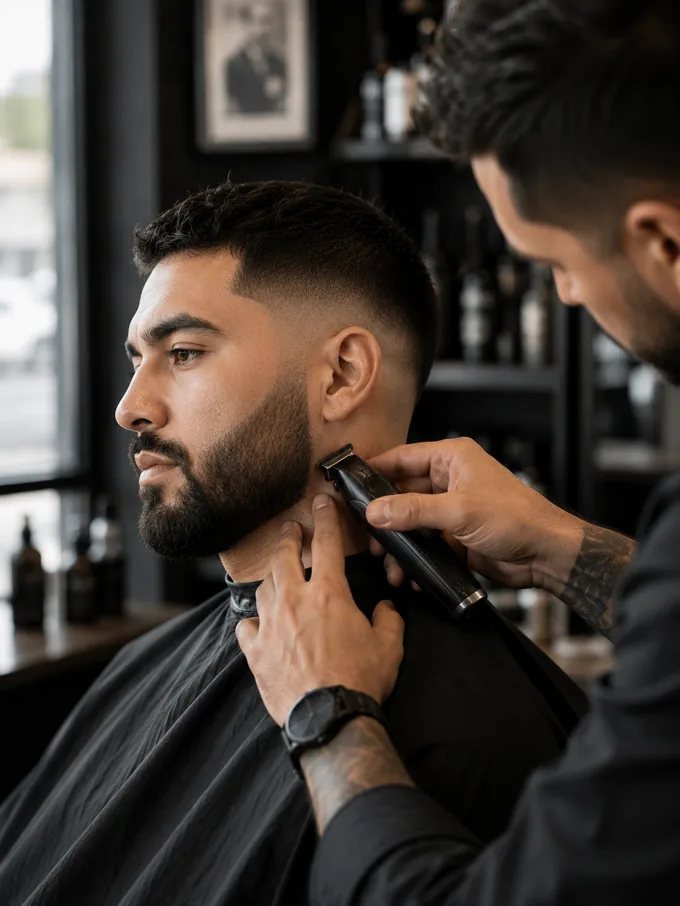
Some shops bundle it, most price it separately. On a mid drop fade the beard needs to connect to where the drop finishes, so if you have one it's rarely optional. Ask upfront whether it's included — this is the most common source of a bigger-than-expected bill.
-
3
Line-up or hard part — add $5–15 / £3–10
A razor line-up or a shaved part is detail work billed on top at many shops. Worth confirming rather than assuming.
-
4
Hot towel finish — add $10–20 / £5–12
Pleasant, entirely optional, and frequently added to premium packages whether or not you asked. Fine if you want it; worth declining if you don't.
-
5
Tipping in the US — add 15–20%
On a $40 cut that's $6–8, and it's expected rather than optional in most US shops. This alone is why a $40 haircut is really a $47 haircut, and it's the single biggest gap between the listed price and what leaves your wallet.
Tipping: US versus UK
This trips people up more than any other pricing question, and most guides skip it entirely.
In the US, tipping is expected. 15–20% of the pre-tax price, given at payment. On a $40 mid drop fade, budget $46–48 total. If a junior member of staff did your shampoo, they're often tipped separately.
In the UK, tipping is not expected. It's appreciated and increasingly common at higher-end shops, but nobody will think twice if you pay the listed price. Rounding up or leaving a couple of pounds is generous, not obligatory. A £20 haircut is a £20 haircut.
If you're comparing US and UK prices and wondering why the gap looks so wide, this is part of the answer. Add 20% to every US figure on this page for a fair comparison.
How to check your local price
-
1
Search your city plus "barbershop" on a booking platform
Most shops now list a full service menu online. Three shops is enough to see your local midpoint, and it's more accurate than any national average — including the ones on this page.
-
2
Look for "fade" or "skin fade" as its own line item
If the menu prices fades separately from a standard cut, that's the number that applies to you. If it doesn't, expect the base price plus $10–20.
-
3
Check the slot length, not just the price
A 40-minute appointment at $45 is usually better value for this cut than a 20-minute one at $35. The drop curve is where rushed work shows first.
-
4
Ask what's included before you sit down
Specifically: is the beard trim in the price, and is a skin finish extra. Both are common surprises. Our barber guide covers the rest of that conversation.
Ways to reduce the cost honestly
- Ask for a taper instead of a fade. A mid drop taper holds its shape for 4–6 weeks rather than 2–3. Same barber, same price per visit, roughly half the annual cost.
- Keep the neckline clean yourself. Five minutes with a trimmer buys you an extra week between appointments without touching the blend. This is the single highest-value habit on the list.
- Go a guard length up at the bottom. A #1 finish grows out more forgivingly than skin, so it stays presentable longer and is often cheaper on the menu.
- Book a standing appointment. Many shops offer a small discount or priority booking for regulars, and it stops you drifting past the point where the cut needs rebuilding.
- Skip the add-ons you didn't ask for. Hot towel finishes and eyebrow work get added by default at some shops. Declining politely is normal.
- Don't chase the cheapest shop for this specific cut. A badly blended drop fade costs you the price of the cut plus the price of fixing it. The DIY route has the same trap.
When paying more actually shows
Not always. For a buzz cut or a simple trim, a budget chain and a premium studio produce results most people couldn't tell apart. Paying more there is paying for the chair.
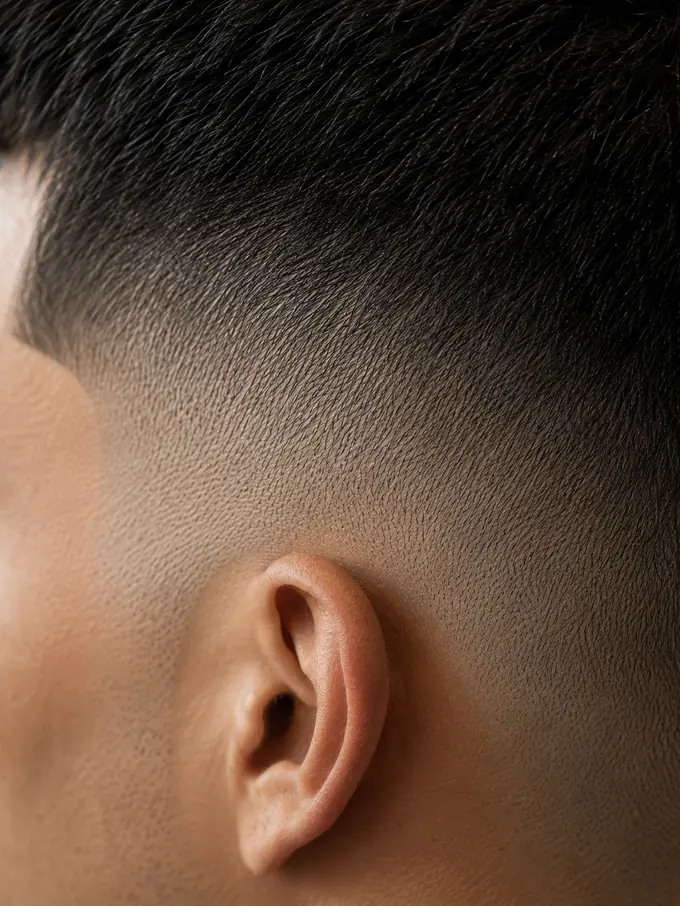
A mid drop fade is one of the cuts where it does show. The curve behind the ear is the hardest part of the haircut to execute, it's the part you can't check yourself in a mirror, and it's the part a rushed 15-minute appointment gets wrong first. A visible line in the blend is the giveaway, and it's obvious to everyone except the person wearing it.
That said, price is a proxy, not a guarantee. An experienced barber at a $35 independent will out-cut an inexperienced one at a $70 studio every time. What you're really buying with money is time in the chair and consistency of person — and you can sometimes get both cheaply by finding a good barber early in their career.