Mid Drop Fade
vs Mid Fade
One line curves behind the ear. One doesn't. That's the entire difference — and it's almost invisible from the front, which is how people end up with the wrong one.
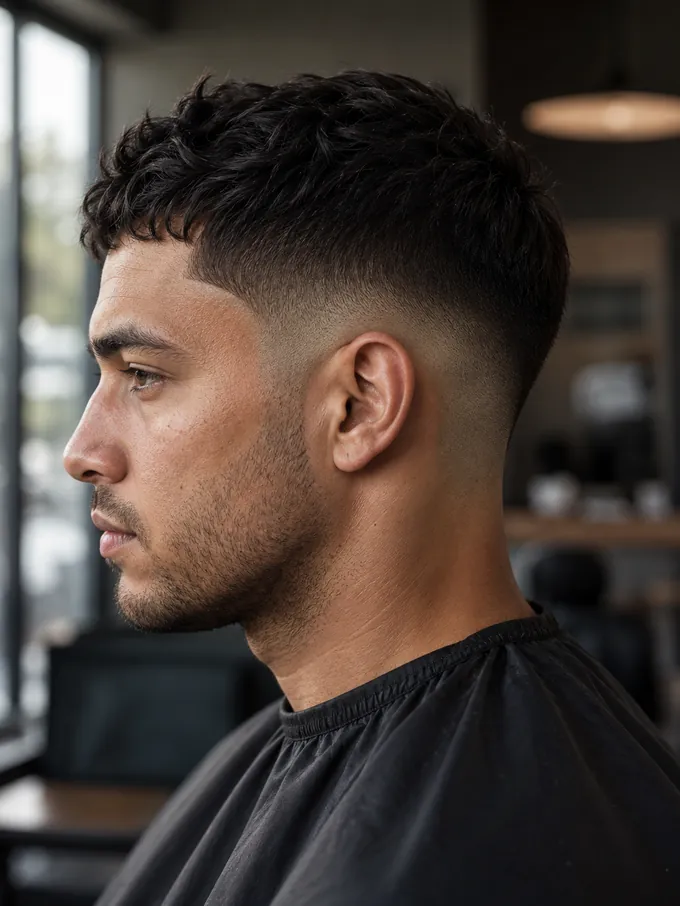
Mid drop fade vs mid fade: the difference
A mid fade holds one height the whole way round — temple, sides, back, all level, like a line drawn parallel to the floor. A mid drop fade starts at the same place and then curves downward as it passes the ear, finishing lower at the nape.
Both begin at mid-temple. Neither is shorter or longer at the front. The only thing that changes is whether the line stays flat or arcs down at the back.
The practical effect: a drop fade cuts more hair close at the back than a mid fade at the same front height. That pulls in bulk behind the ears, gives a cleaner neckline profile, and adds a flowing shape rather than a hard horizontal band.
Two paths around the same head
Drawn as lines it's obvious. On an actual head it's far more subtle — which is the whole reason this comparison confuses people.
Mid drop fade vs mid fade in real life
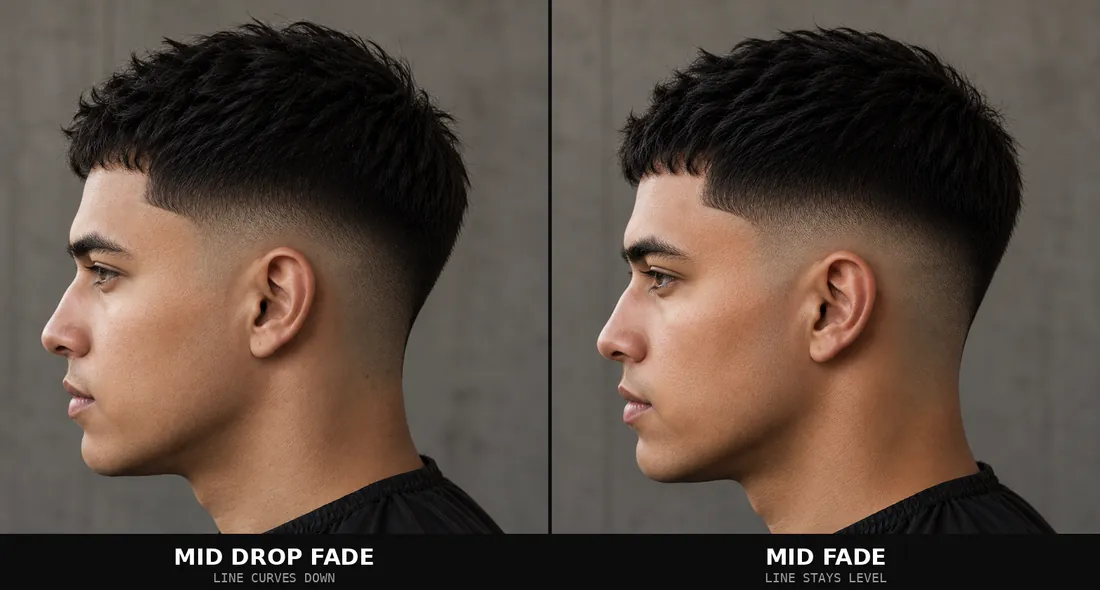
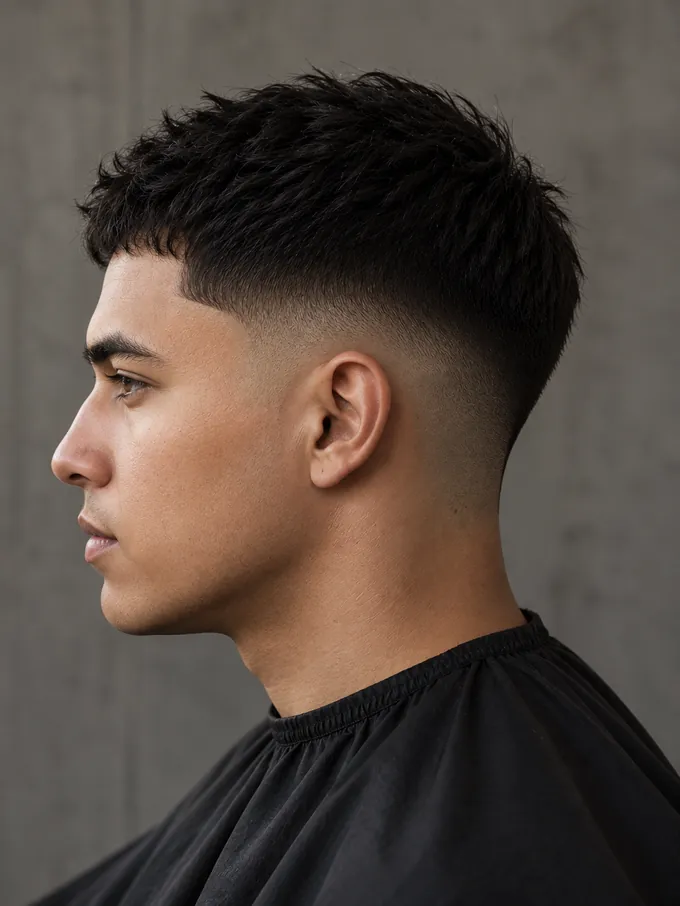
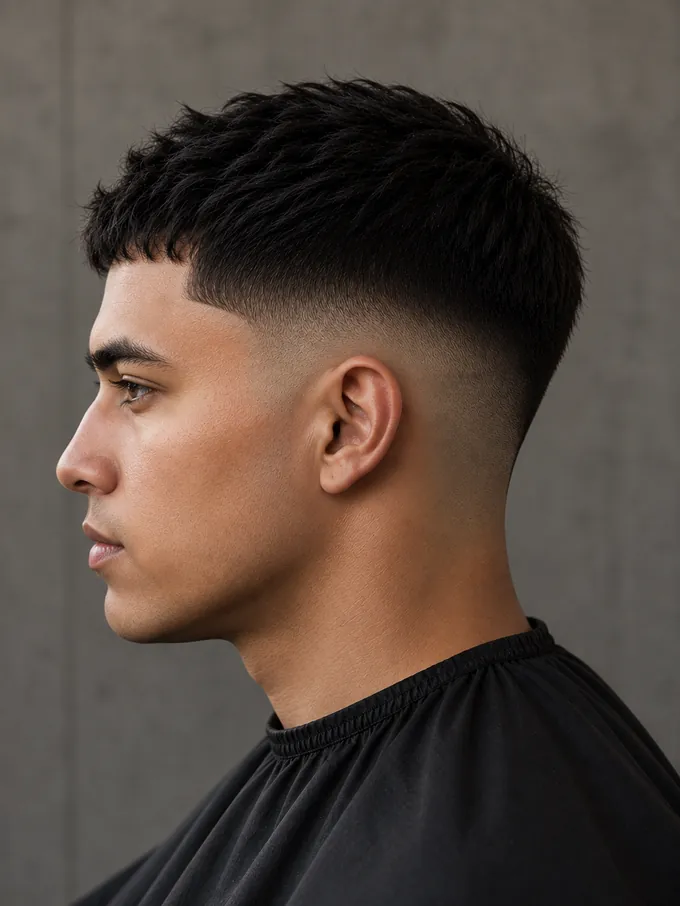
Being straight with you: the difference is subtle here, and that's the point. From the front the two cuts are nearly identical. In profile you have to look for it. The drop only becomes obvious from behind, where it forms a shallow U across the nape instead of a straight band. That's why so many men ask for one and walk out with the other — and why a side-profile reference photo matters more on this cut than almost any other.
Three settings, not one choice
Fade terminology gets confusing because people treat every name as a separate haircut. It's cleaner to think of a fade as three independent settings, and "drop" is only one of them:
1. Shape — level or drop. Does the line stay flat, or curve down behind the ear? That's what this page is about.
2. Height — low, mid, or high. Where does the fade begin on the side of your head? Covered in mid vs low drop.
3. Closeness — guard length or skin. How short does it go at the bottom? Covered in mid drop vs skin fade.
These combine freely. A "low drop skin fade" is a drop shape, at low height, taken to skin — three settings, not one exotic cut. Once you see it this way, every fade name on a barbershop menu decodes itself, and asking for what you want gets much easier.
Mid drop fade vs mid fade compared
| Attribute | Mid Drop Fade | Mid Fade |
|---|---|---|
| Line path | Curves down behind the ear to the nape | Level all the way around |
| Starting height | Mid-temple | Mid-temple — identical |
| Hair removed at the back | More — the line sits lower | Less — stays at front height |
| Visible from the front | Barely distinguishable from a mid fade | Barely distinguishable from a drop |
| Visible from behind | Clearly — a shallow U at the nape | A straight horizontal band |
| Reads as | Modern, flowing, sculpted | Classic, uniform, understated |
| Head shape effect | Pulls in bulk behind the ears, slims a rounded back | Neutral — follows no contour |
| Barber skill needed | Higher — the arc must match on both sides | Lower — a level line is easier to keep even |
| Rebook every | 2–3 weeks | 2–3 weeks, marginally more forgiving |
| Best with | Textured crops, curls, quiffs — tops with visual weight | Anything, including very short tops |
Where the drop actually shows
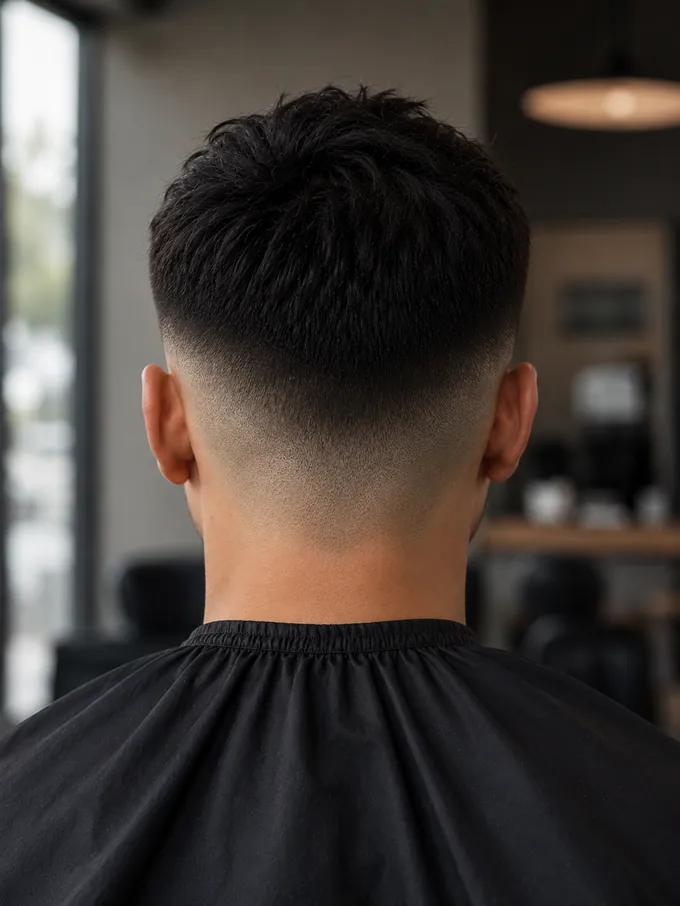
When the drop isn't worth asking for
- If your top is very short. On a buzz cut or close crop there's barely any top section for the curve to frame, so the drop and a level fade look nearly the same. You're paying for precision you can't see.
- If your hair is thinning or flat on top. The drop is a strong shape. With a weak top it takes over — sides looking worked-on, top not holding its end up, and the whole cut reading as unbalanced.
- If your barber mainly cuts level fades. The arc needs deliberate technique and muscle memory. A barber used to horizontal lines can do it, but the first attempt may be uneven. Ask to see examples first.
- If you can't commit to the schedule. A curve going out of shape looks worse than a straight line going out of shape, because asymmetry is more obvious on an arc.
- If you only ever see yourself from the front. Said honestly: this is a cut that pays off in profile and from behind. If that doesn't matter to you, a mid fade gets you 90% of the look for less fuss.
Head shape and hair type
The drop suits rounder head shapes at the back. Because the line sits lower behind the ear, it removes bulk exactly where a round head is widest. A level mid fade leaves that bulk in place. If your sides puff out around the temples and ears between cuts, the drop pulls that in.
The drop suits tops with visual weight. Textured crops, curly hair, quiffs, anything with volume. The curve frames that volume and makes the silhouette look deliberate. On a flat top there's nothing to frame.
The mid fade suits straight, fine hair better. Straight hair shows every line clearly, and a level fade is easier to execute perfectly on it. A slightly uneven arc is far more noticeable on straight hair than on curly.
For face shape, a drop generally flatters round, oval and square faces by adding length and contour. On a long face, height matters more than shape — go lower with either version.
Mid drop fade vs mid fade: which should you get?
Choose the mid drop fade if: you keep some length or texture on top, you like a strong side and back profile, your head is fuller at the back, and you have a barber who cuts drops regularly.
Choose the mid fade if: your top is very short, your hair is fine or straight, you want the most forgiving option to execute and maintain, or you're at a new barber and don't know their work yet.
Good news either way: switching costs nothing. A barber can add the drop at your next visit without growing anything out, and can flatten it back just as easily.
Still deciding? Try the fade finder quiz.
How to ask for each
For the mid drop fade
"Mid drop fade, a #1 into a #3. Start at mid-temple, and let the line drop down behind my ear to the nape rather than staying level."
For the standard mid fade
"Mid fade, #1 into a #3. Keep the line level the whole way round — no drop at the back."
If you're not sure your barber does drops
"Do you cut many drop fades? Can I see a photo of one you've done?"