Mid Drop Fade
vs High Drop Fade
Take the fade higher and you gain contrast but lose forgiveness. See both on the same head, and the one thing a high fade puts on display that nobody warns you about.
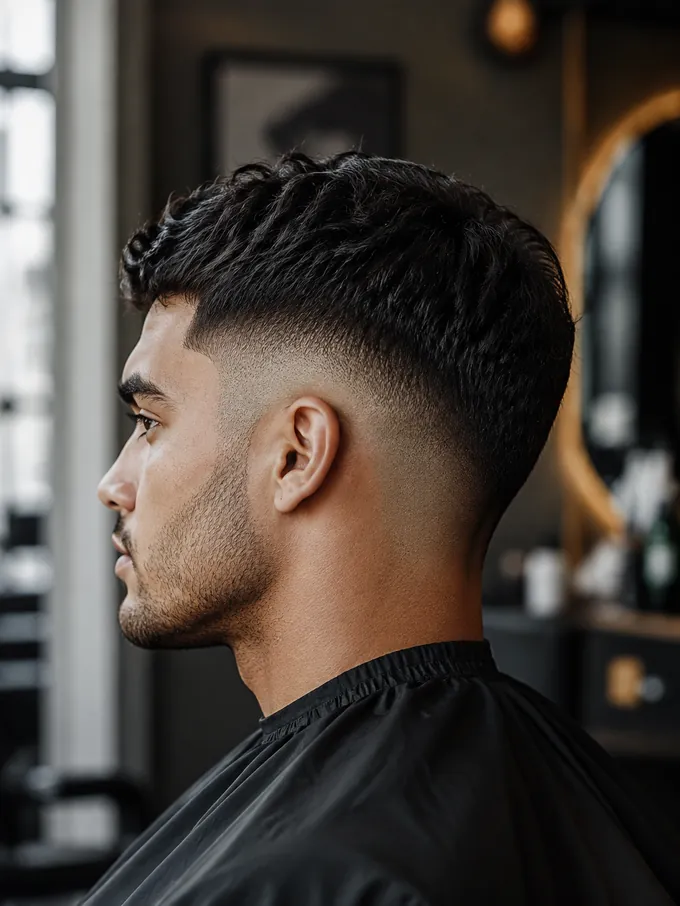
Mid drop fade vs high drop fade: the difference
A mid drop fade starts around mid-temple, level with the eyebrow, leaving a substantial band of longer hair above it. A high drop fade starts up near the crown, so almost the whole side is faded and only the top section remains.
Both curve downward behind the ear to the nape. The drop is identical. What changes is how much of your head is faded — and going high roughly doubles it again over the mid.
The trade: the high drop gives you maximum contrast and makes the top section the clear focus. It also grows out worse, suits fewer people, gives your barber almost no room to correct, and puts the actual shape of your skull on display.
Mid drop fade vs high drop fade: how much gets faded
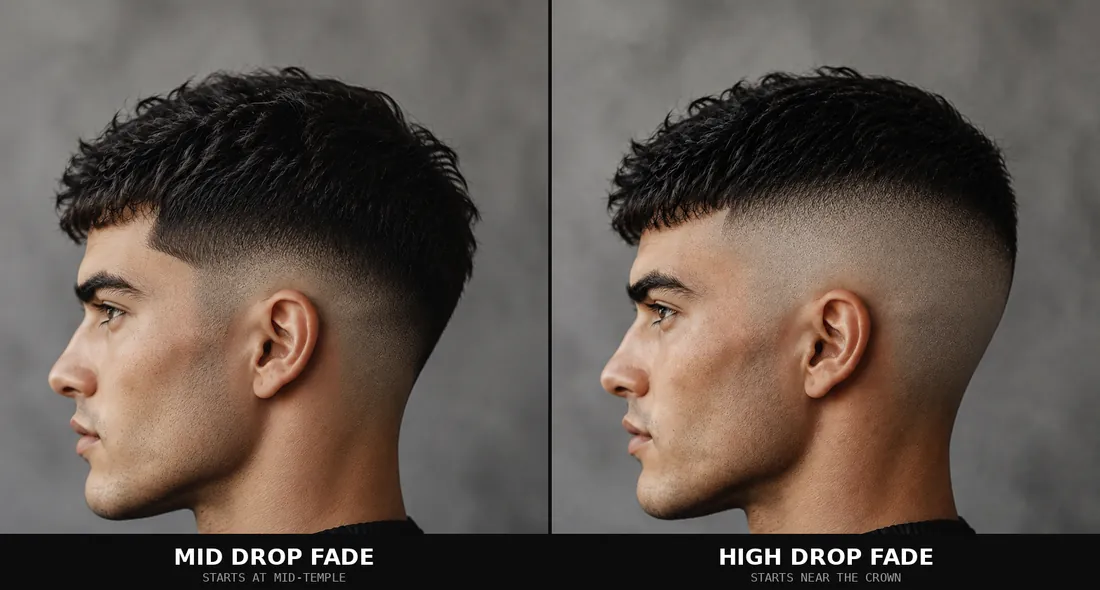
The curve gets longer as you go higher
On a level fade the height is just a starting point. On a drop fade it's also the top of an arc — and the higher that arc starts, the further it has to travel down to the nape.
That makes a high drop fade the most technically demanding version of this cut. A longer curve means more distance over which the gradient can go uneven, and more surface where the left and right sides can fail to match. Small errors that would hide inside a mid fade have nowhere to go.
It also means the drop is at its most visible here. If the curve is what drew you to this haircut, the high version shows it off most. Just know you're asking more of whoever is holding the clippers — it's worth checking their work first, as the barber guide covers.
Does a high fade suit a round face?
Search this and you'll get both answers. Some guides say a high fade flatters round faces by adding height. Others say it makes them look wider. Both are half right, and the missing variable is the top.
A high fade with height on top elongates a round face. Narrow sides plus vertical volume creates a column effect that adds the length a round face lacks. That's the version those guides are praising.
A high fade with a flat, wide top does the opposite. The remaining hair sits as a broad slab above tight sides, which reads as width rather than height, and emphasises exactly what a round face doesn't need.
So the honest answer: for a round face, a high drop fade works if you commit to keeping height on top. If you'd rather have a short, flat top, the mid is the safer call. Same reasoning applies to a square face, with the added note that a high fade emphasises jaw width — good if you like your jaw, less so if it's already very wide.
Mid drop fade vs high drop fade compared
| Attribute | Mid Drop Fade | High Drop Fade |
|---|---|---|
| Starts at | Mid-temple, level with the eyebrow | Near the crown, well above the temple |
| Faded area | Most of the lower side | Nearly the entire side and back |
| The drop curve | Present | Present, longer and more visible |
| Contrast | Strong | Maximum |
| Rebook every | 2–3 weeks | 1–2 weeks — grows out of shape fastest |
| Yearly cost at $40/cut | ~$680 before tips | ~$1,040 before tips |
| Forgiveness | Some — the barber has room to balance | Almost none — errors have nowhere to hide |
| Shows your head shape | Partly | Fully — flat spots and bumps become visible |
| Needs on top | Works with any length | Needs real length or volume to balance it |
| Thinning at the crown | Reasonably forgiving | Poor — draws the eye straight to the top |
| Thinning at the hairline | Neutral | Can help — redirects attention off the front |
| Conservative workplaces | Fine in most | Often too bold |
Where each fade begins
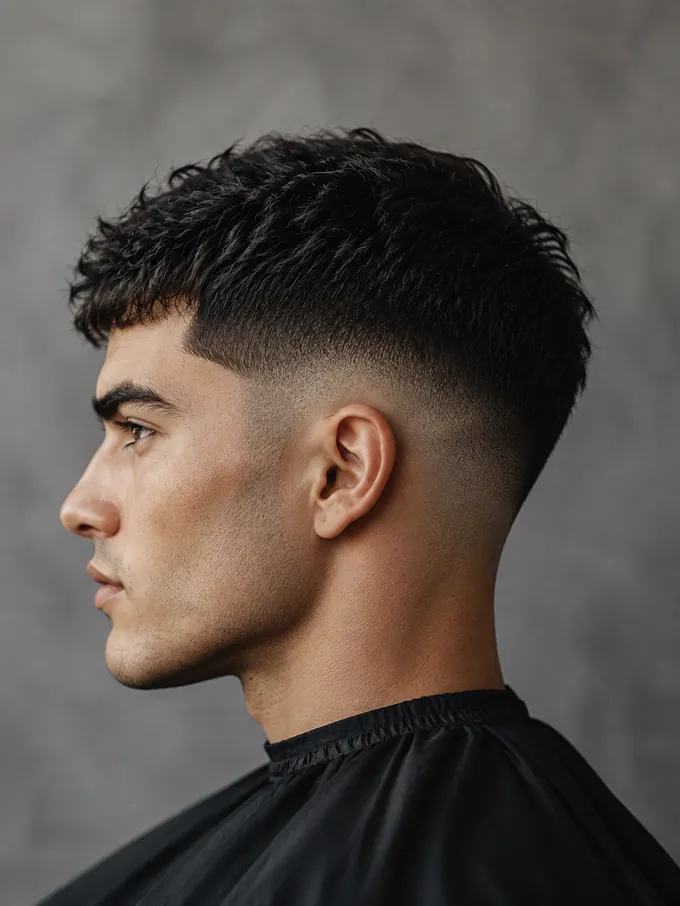
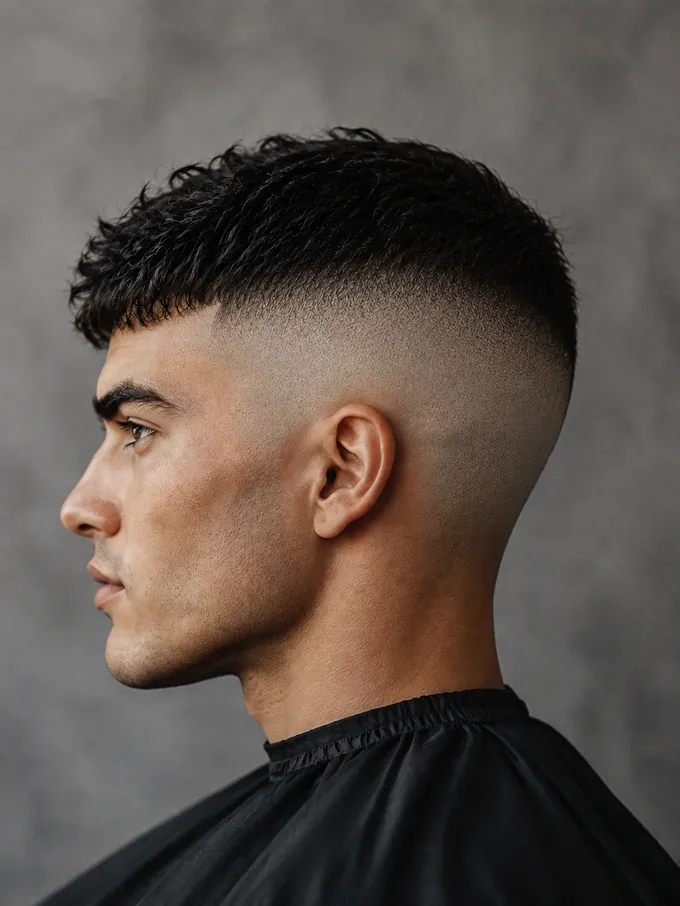
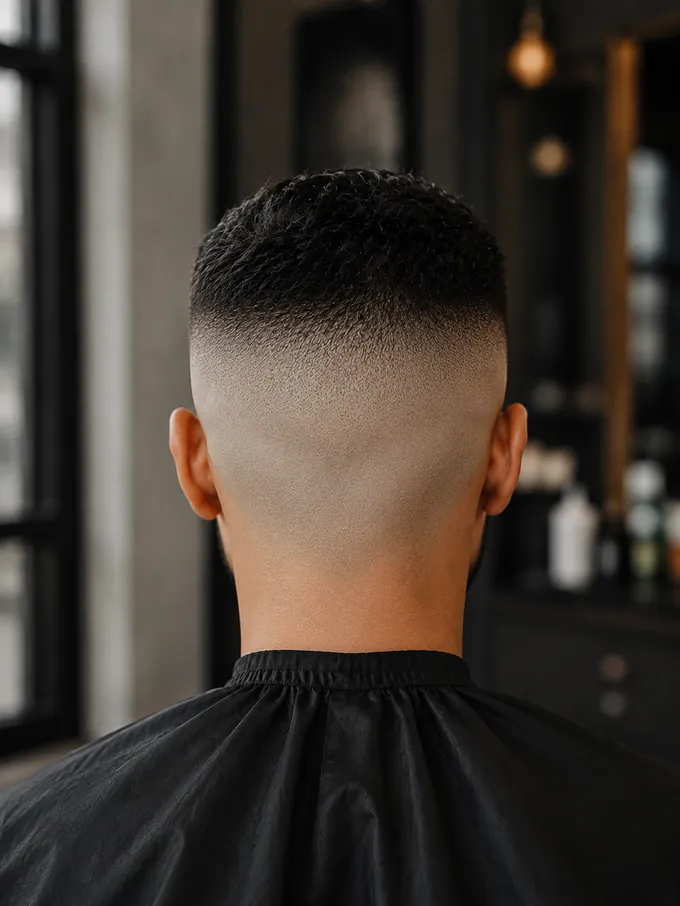
A high fade puts your skull on display
Hair hides the shape of your head. Take it away and whatever's underneath is visible.
Most people have never seen their own head shape properly, because they've never had it exposed. Flat spots at the back, an asymmetric occipital bone, childhood scars, a pointed crown — a mid fade covers all of it with the band of hair above the fade line. A high drop fade doesn't.
This isn't a reason to avoid a high fade. Plenty of people have an even head shape and it looks excellent. It's a reason to find out first. Ask your barber during consultation: "how's my head shape for going higher?" A good one will tell you honestly, and it takes ten seconds.
The same applies to the skin finish question — going to bare scalp compounds it further.
When not to go high
- If you're thinning at the crown. A high fade removes everything around the top section, so all attention lands on the one area you'd rather it didn't. The mid keeps some coverage in play.
- If your top is short or flat. A high fade needs something substantial on top to balance against. Without it the cut looks unfinished rather than bold.
- If you have curly hair and want to keep the shape. Barbers consistently say people go too high with curls and lose the support the curl pattern needs to sit properly. A mid drop usually frames curls better.
- If you can't get to a barber fortnightly. A high fade grows out of shape faster than any other height, because there's more faded area for regrowth to blur.
- If you're trying it for the first time. Going higher takes one appointment; coming back down takes six weeks or more of growing out. Start at mid and climb if you want to.
Mid drop fade vs high drop fade: which should you get?
Choose the mid drop fade if: you want a cut that suits most situations, you'd like some room for error, your top length varies, or you'd rather not commit to a fortnightly barber schedule. It's the default for a reason.
Choose the high drop fade if: you want maximum contrast, you keep real length or volume on top, your head shape is even, you have a barber whose fades you trust, and the schedule is genuinely realistic for you.
Start at mid if you're unsure. Going up is one appointment. Coming back down is over a month of growing out. The asymmetry always favours starting lower — the same logic as mid vs low.
Still deciding? Try the fade finder quiz.
How to ask for each
For the mid drop fade
"Mid drop fade, a #1 into a #3. Start it at mid-temple, level with my eyebrow, and drop the line behind the ear to the nape."
For the high drop fade
"High drop fade — take it up near the crown, and keep the drop curving down behind the ear. Leave enough length on top to balance it."
Before committing to high
"How's my head shape for taking it higher? Anything I should know before we do?"