How To Ask Barber
For Mid Drop Fade
Barbers work in guard numbers, not adjectives. Learn how to ask barber for mid drop fade in the exact language they use — plus reference photos you can show them.
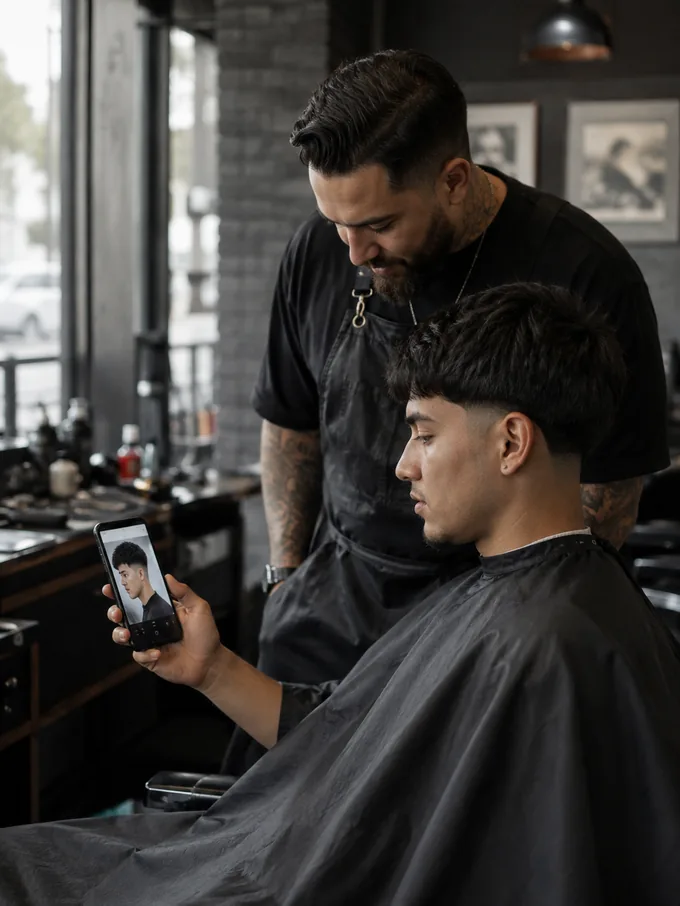
"Fade" on its own means almost nothing
Walk in and say "fade the sides" and you've told your barber roughly one percent of what they need. Fade is a category, not a cut. It covers low, mid, high, drop, burst, taper and skin — styles that look genuinely different from each other, all sitting under one word.
Learning how to ask barber for mid drop fade properly comes down to giving three pieces of information, in the order barbers think about them: how short at the bottom, how long further up, and where the line sits. Everything else is detail.
The good news is that this is a short vocabulary. Roughly six numbers and three phrases cover it, and once you know them you can specify any fade in a single sentence. Barbers genuinely prefer clients who can do this — it takes the guesswork out and means fewer corrections halfway through.
Clipper guard numbers
Guards are the plastic attachments that control how much hair is left behind. Lower number, shorter cut. This is the single most useful thing to know walking into a barbershop, and most people never learn it.
| Guard | Length left | What it looks like |
|---|---|---|
| #0 / no guard | Bare skin | Shaved down. This is what makes a fade a "skin fade" at its lowest point. |
| #0.5 | ~1.5 mm | Barely there, but not bare. A softer bottom than a true skin fade. |
| #1 | 1/8 inch (3 mm) | Very short, scalp clearly visible through it. The most common starting point for a drop fade. |
| #1.5 | ~4.5 mm | A half-guard used mainly for blending between #1 and #2. |
| #2 | 1/4 inch (6 mm) | Short but with visible density. A common finishing length at the top of the fade. |
| #3 | 3/8 inch (10 mm) | Noticeable length. Where a fade starts feeling softer and less contrasted. |
| #4 | 1/2 inch (13 mm) | About the practical ceiling for sides. Beyond this, scissor work usually looks better than clippers. |
Two things worth knowing: guard numbers vary slightly between clipper brands, so a #3 in one shop may run marginally longer than another. And barbers use a lever on the clipper to hit lengths between the numbered guards — that in-between control is exactly what makes a fade blend invisibly.
The "number into number" formula
Barbers describe fades as a transition between two lengths. Once you phrase it that way, you're speaking their language:
The first number is the shortest point, at the bottom of the fade. Choose #0 if you want it skin-close, #1 for very short with some coverage, #2 for a softer look.
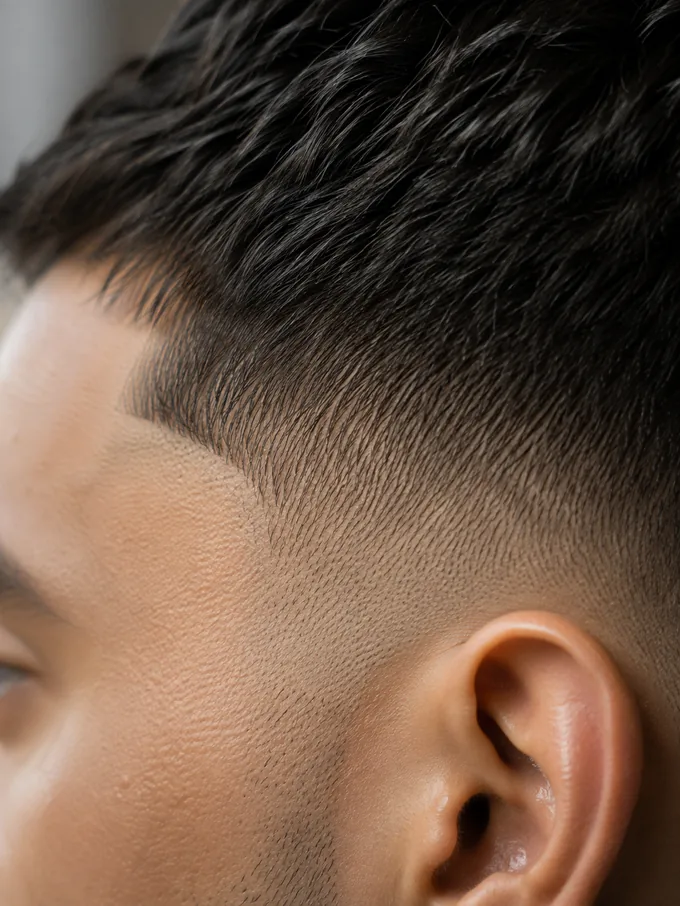
The second number is what it blends up into at the top of the sides. #2 or #3 is standard for a mid drop fade. Higher contrast means a bigger gap between the two numbers.
The drop instruction is what makes it a drop fade rather than a standard one. This is the part most people miss, and it's the whole difference between this cut and a regular mid fade.
The top is a separate decision. Say it in plain language — "about two inches," "finger length," or "keep most of what's there." You don't need technical terms for the top.
Where each drop height starts
How to ask barber for mid drop fade with photos
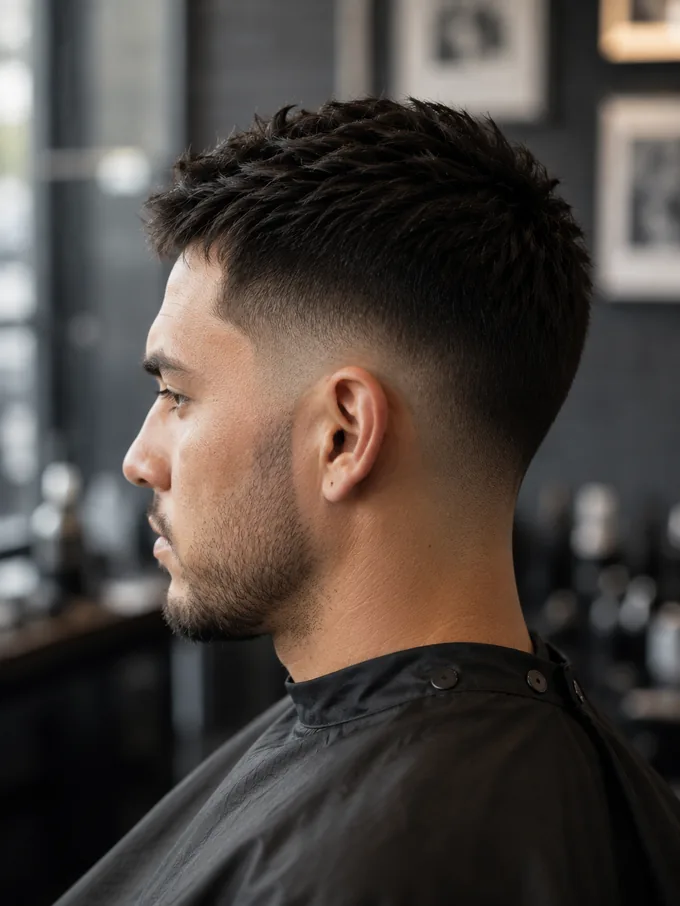
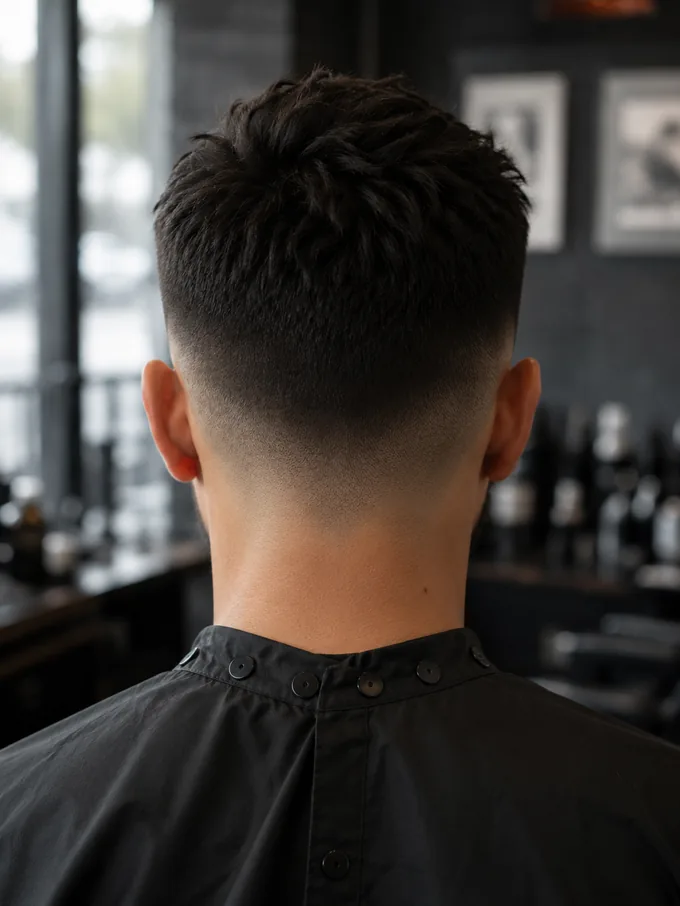
Save these to your phone before your appointment. A side profile is worth more than a front-facing shot here, because the drop curve only exists in profile — from the front, a drop fade and a level fade look nearly identical.
What to do in the chair
-
1
Lead with the photo, then the numbers
Show the side profile first, then say the sentence. The photo sets the picture; the numbers pin down the detail. Frame it as a starting point rather than a demand — the cut has to work on your head shape and hairline, not the model's.
"Something like this — a #1 into a #3, dropping behind the ear." -
2
Point, don't just describe
If you're unsure of the terminology, touch the spot on your own head where you want the fade to begin. Barbers find this clearer than any technical name, and it removes every possible misreading in one gesture.
"I want the blend to start about here." -
3
Say the word "drop" explicitly
This is the detail that separates the cut from a standard fade. If your barber doesn't use the term, describe the shape: a line that starts at mid-temple and curves downward behind the ear to the nape, instead of staying level.
- 4
-
5
Ask to see it before the edges are finished
Once the neckline and edge-up are done, adjustments get much harder. A quick check just before that stage costs nothing and is the last easy moment to change anything.
"Can I take a look before you do the edges?" -
6
Ask what guards they used, and write it down
The single most useful thing you can do. If you love the cut, note the numbers in your phone. Next visit — or at a new shop — you can reproduce it exactly instead of starting the conversation over.
Say this, not that
Neckline, sideburns, and edge-up
Knowing how to ask barber for mid drop fade includes these three, which get decided by default if you don't mention them, and they're the parts people notice afterwards and can't explain.
Neckline. Three options: squared off, rounded, or tapered. A tapered neckline grows out most naturally and is the usual match for a drop fade, since it follows the same downward logic. Squared looks sharper for the first week but shows regrowth faster.
Sideburns. Say how long and whether you want them squared or angled at the bottom. On a mid drop fade, the sideburn is where the fade meets your face, so it's more visible than on other cuts.
Edge-up. A razor line around the hairline looks sharp immediately but grows back itchy and creates a hard border. Ask for a softer, natural edge instead if you're stretching more than three weeks between cuts.
If you have a beard, say whether you want it connected to the fade or kept separate. On this cut the drop line lands near where a beard fade would start, so they need to be planned together. The beard pairing guide covers how that blend works.
What to say if it's going wrong
Speak up early. This is the part people find hardest and it's the part that matters most — a fade can be corrected while it's being cut, and almost never afterwards.
If the fade is climbing too high: "Could you keep the fade line a bit lower than that?" Say it the moment you notice. Hair that's already off can't go back on, but the line can still be adjusted downward while there's length above it.
If it looks level rather than dropping: "Can we bring the line down more behind the ear?" This is usually fixable right up until the blend is finished.
If the top is going shorter than you wanted: stop them straight away. Top length is the one thing with no recovery.
If you only notice afterwards: most barbers will fix a genuine miscommunication if you return within a few days, and would rather do that than lose a client. Be specific about what's wrong rather than saying you don't like it.
Common mistakes
Assuming guard numbers are exact measurements. They're not — a #3 varies slightly between clipper brands. Use them as the shared reference point they are, not as millimetre precision.
Bringing only a front-facing photo. The drop is invisible from the front. If your reference doesn't show the side of the head, it isn't showing the thing that defines this cut.
Asking for a number above #4 on the sides. Past that length, clippers stop looking clean and scissor work is the better tool. If you want longer sides, say "scissor-cut the sides" rather than naming a high guard.
Booking a drop fade with a barber who hasn't done one. The curve is harder to blend than a level line. It's a fair question to ask before you sit down, and any decent barber will answer honestly.
Not saying anything until you're out the door. Barbers can't fix what they don't know about, and once the edges are done the options narrow fast.