Mid Drop Fade
vs Burst Fade
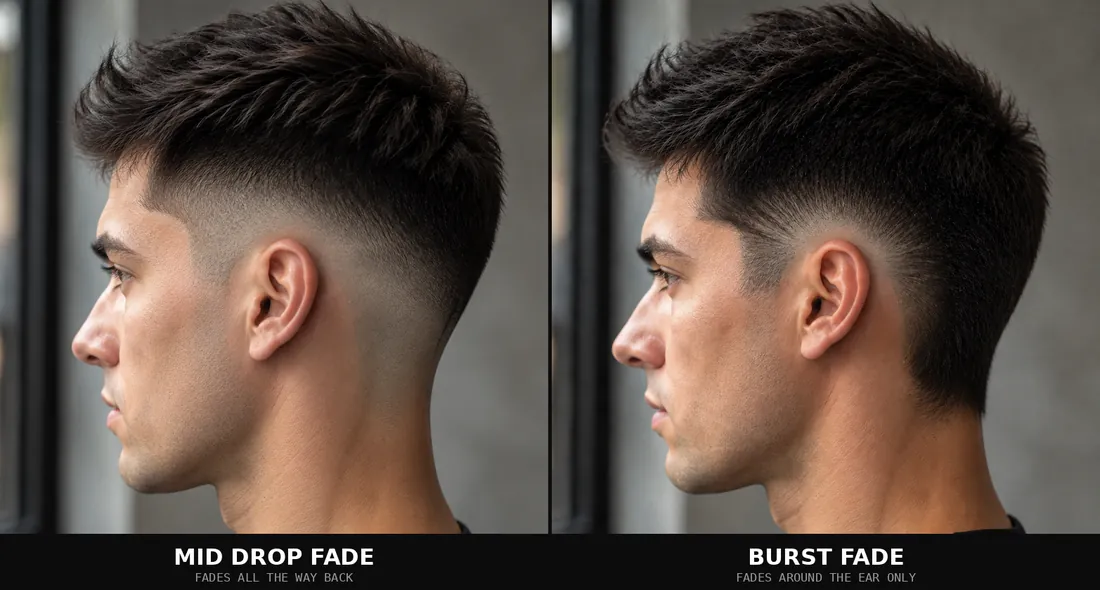
One fades the whole side to the nape. The other fades only around the ear and leaves the back long — which is why it's really a mullet haircut.
Mid drop fade vs burst fade: the difference
A mid drop fade fades continuously along the entire side and carries on around to the nape, so the back of your neck ends up short. A burst fade fades in a semicircle around the ear only — the hair in front of it stays long, and crucially the hair behind it stays long too.
So on a burst fade the nape isn't faded at all. It keeps length, often deliberately, running down toward the neck. That's not a side effect. It's the entire purpose of the cut.
Which leads to the thing nobody says outright: the burst fade exists to preserve length at the back. That's the definition of a mullet. If you don't want length at the back, you almost certainly don't want a burst fade.
Mid drop fade vs burst fade: the shape of each
A burst fade is a mullet haircut
Search "burst fade" and look at what comes back. Nearly every result is about burst fade mullets. That isn't a coincidence or a passing trend in the content — it reflects what the cut is for.
The burst leaves the back long because something is meant to go there. Whether that's a full mullet, a shorter modern version, or just a longer textured back section, the cut is designed around keeping weight behind the ears. Fade the sides in a circle, leave the back, and you've made a mullet — whatever you call it.
By contrast, a mid drop fade is neutral. It works with a buzzed top, a quiff, a comb-over, curls, anything. It doesn't commit you to a silhouette.
None of this makes the burst a worse cut. It makes it a specific one. Going in asking for a burst fade because you saw it trending, without wanting the length at the back, is how people end up confused by their own haircut. If you like the burst but not the mullet, what you actually want is probably a low drop fade.
Mid drop fade vs burst fade compared
| Attribute | Mid Drop Fade | Burst Fade |
|---|---|---|
| Fade shape | A continuous line, temple to nape | A semicircle radiating around the ear |
| The nape | Faded short | Left long — the defining feature |
| In front of the ear | Faded | Often left longer |
| Commits you to | Nothing — works with any top | Length at the back, i.e. a mullet silhouette |
| Reads as | Clean, modern, broadly acceptable | Bold, trend-driven, expressive |
| Technical difficulty | High — the curve must match both sides | Higher — a circular arc shows unevenness fastest |
| Rebook every | 2–3 weeks | 2–4 weeks, plus separate care for the length |
| Maintenance zones | One — the fade | Two — the fade and the back length |
| Conservative workplaces | Fine in most | Often too bold |
| Best face shapes | Round, square, oval | Oval, square, heart — round wants a higher burst |
| Best hair types | All | Curly and wavy, where back volume is the point |
Where each fade stops
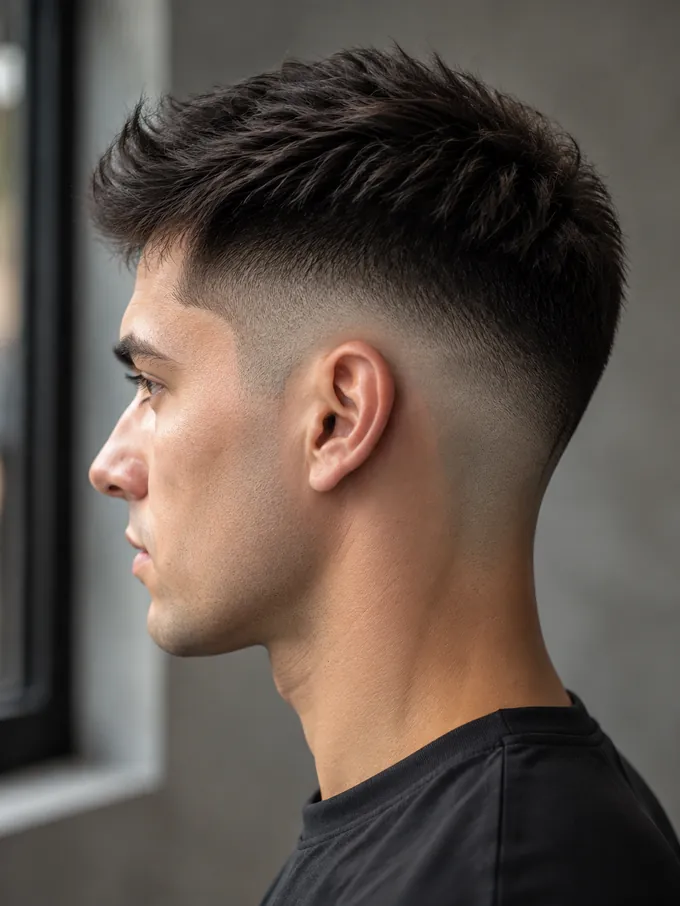
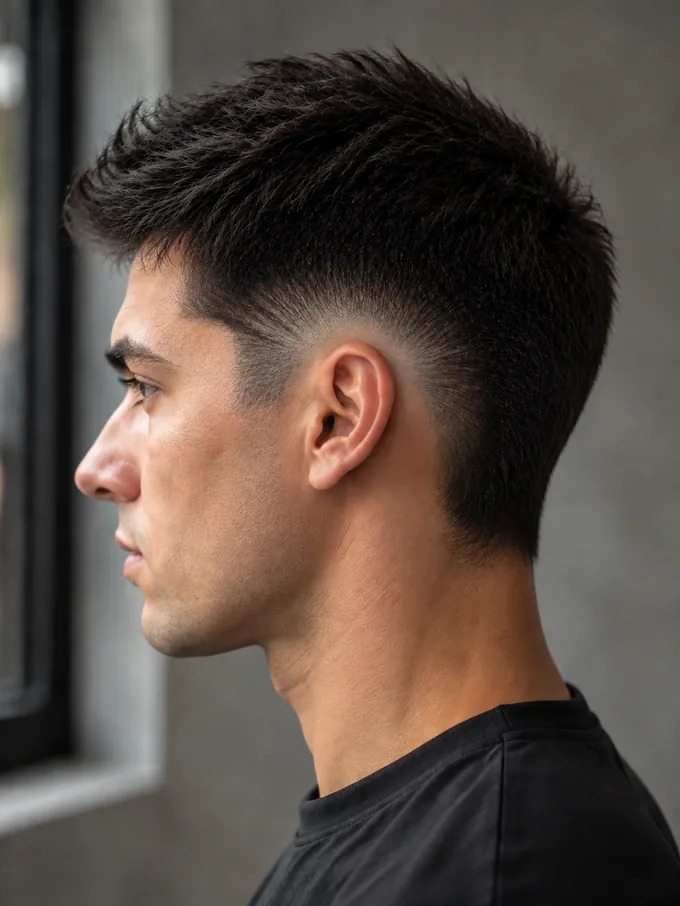
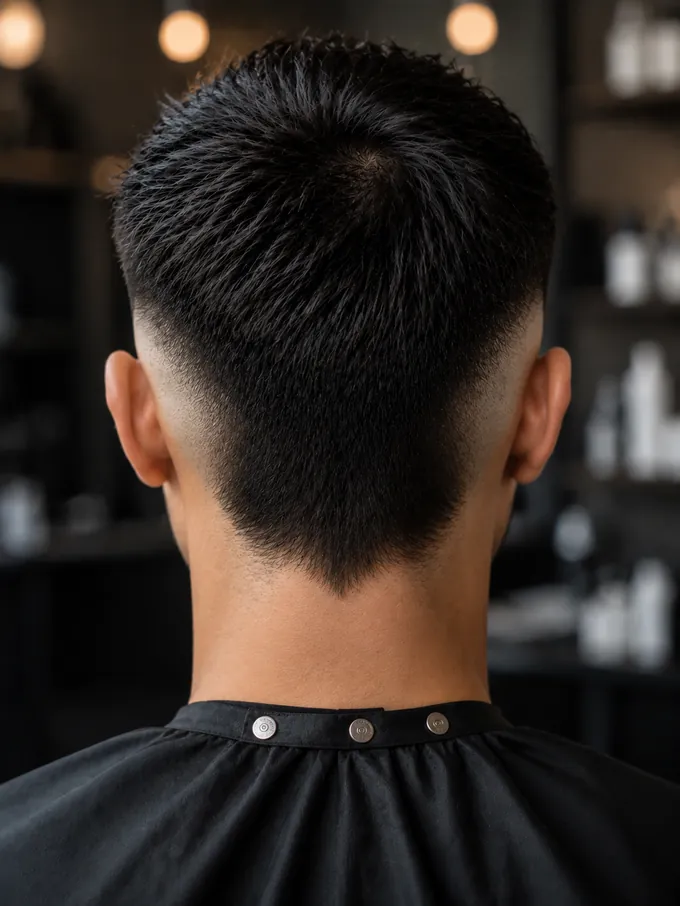
Two zones instead of one
A mid drop fade is one thing to maintain. A burst fade is two.
With the drop, everything below the top section is faded, so a single barber visit resets the whole cut. Rebook every 2–3 weeks and you're done.
With the burst, you're maintaining a fade and a length section, and they have different needs on different schedules. The fade around the ear softens in 2–3 weeks. The back length needs conditioning, light styling and its own shaping to avoid looking flat or straggly. Neglect either one and the cut stops working — a sharp burst with a shapeless back looks unfinished, and a well-kept back over a grown-out burst looks accidental.
Most burst fade wearers also run a detail trimmer over the ear line and neckline every 10–14 days between visits. That's realistic upkeep, not a complaint — just worth knowing before you commit.
When the burst isn't the right call
- You don't want length at the back. This is the big one. Take away the length and a burst fade has no reason to exist — you've just got an oddly-shaped fade around your ears.
- Your workplace is conservative. A drop fade passes almost anywhere. A burst reads as a deliberate style statement, because it is one.
- You want a cut that ages well. The drop has been a barbershop staple for years. The burst is riding a specific trend cycle. That's fine if you like it now, but photos date differently.
- Your hair is fine or straight and flat. The back section needs body to look intentional. Without it, the length reads as neglect rather than design.
- Your barber hasn't cut many. A circular arc around the ear shows asymmetry faster than any other fade shape. There's nowhere for an uneven line to hide.
The detail nobody asks about: the neckline
Because a burst fade leaves the nape long, the neckline becomes a visible design choice rather than a technicality. On a drop fade it's mostly hidden in the blend; here it's the bottom edge of your haircut.
Squared looks sharpest immediately but shows regrowth fastest and doesn't suit every natural hairline. Tapered grows out most cleanly and is the safest default. Rounded softens the look and suits curlier hair.
Barbers will pick one by default if you don't say. If you have a hairline that doesn't sit square naturally, a good barber should flag it — but it's worth raising yourself. The barber communication guide covers how.
Mid drop fade vs burst fade: which should you get?
Choose the mid drop fade if: you want a clean cut that works with any top style, you'd rather not commit to a specific silhouette, your workplace is anything less than relaxed, or you want one maintenance schedule rather than two.
Choose the burst fade if: you genuinely want length at the back, you have curly or wavy hair with natural body, you like the mullet-adjacent look, and you have a barber who cuts them regularly.
Choose neither if: you liked the burst in photos but don't want the back length. What you're actually after is a low drop fade — similar softness around the ear, no commitment to a mullet.
Still deciding? Try the fade finder quiz.
How to ask for each
For the mid drop fade
"Mid drop fade, a #1 into a #3. Start at mid-temple and carry the line down behind my ear all the way to the nape."
For the burst fade
"Burst fade around the ears, and leave the length at the back — don't fade the nape. Tapered neckline please."
If you're unsure about the back length
"Can we keep the back a bit shorter this time and I'll grow it out if I like it?"