Mid Drop Fade
for Round Face
A mid drop fade round face pairing works best with a higher drop point and added height on top — here's exactly how to get it right.

Why it
works
A mid drop fade round face pairing has one job: breaking up width. A round face has soft, even curves with width and height in close balance, which means a fade that sits low and stays level can end up emphasizing that width instead of breaking it up.
Raising the drop point to mid-temple height, or slightly above, does two things: it adds visual length by drawing the eye upward, and it creates a sharper contrast line that gives the face more defined edges than its natural curve has on its own. This is the same logic behind why a standard mid drop fade already starts higher than a low fade, round faces just benefit from leaning into that even more.
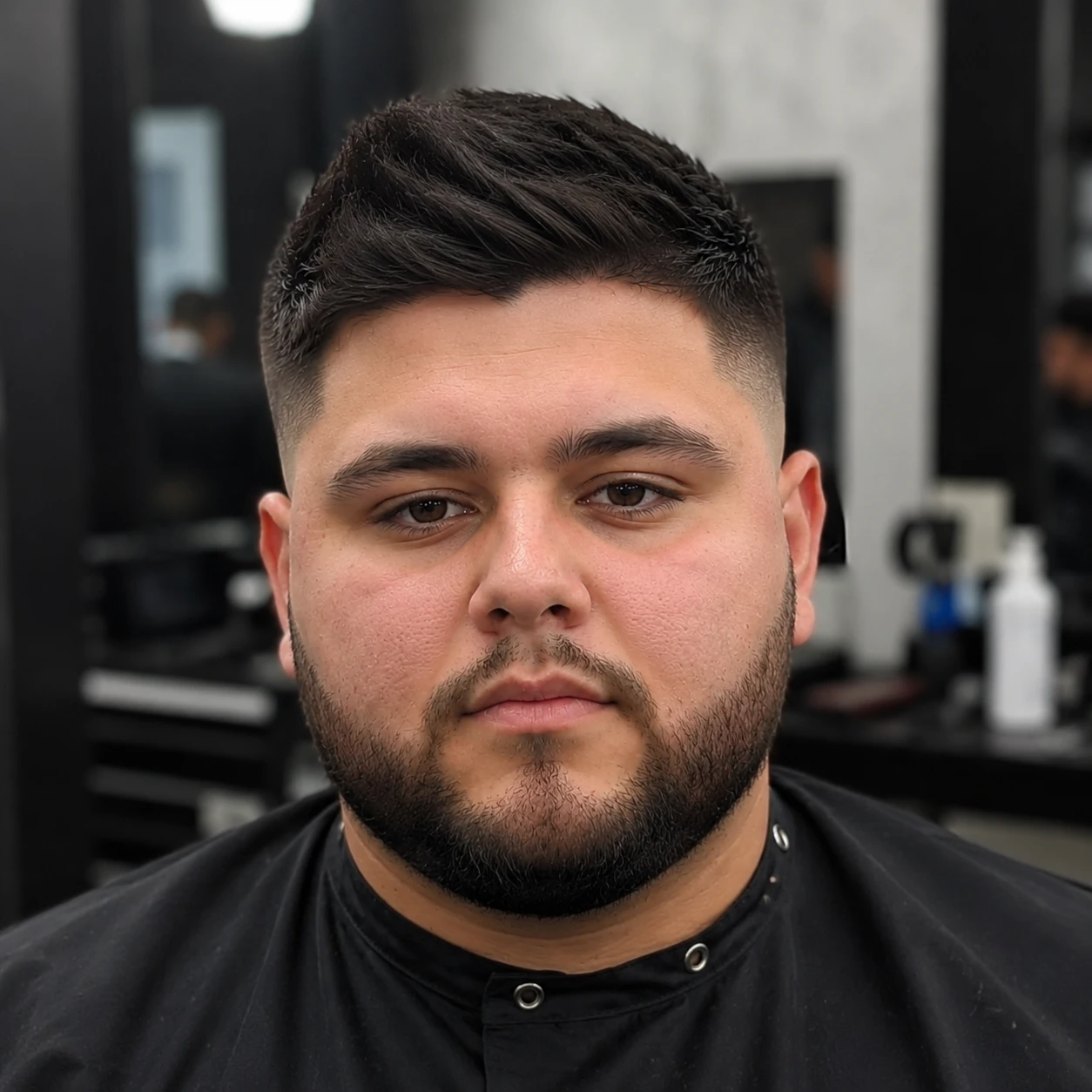
Pairing it with extra height or texture on top reinforces the effect further, which is why the mid drop fade round face styles below tend to outperform flatter, low-volume cuts.
Is your face actually round?
Plenty of guys looking up a mid drop fade round face guide actually have a square or oval shape, and the recommended drop height is different for each. A quick way to check:
- Pull your hair back off your forehead and face a mirror straight on.
- Trace the outline of your face on the mirror, or just follow it with your eyes from hairline to chin.
- Compare the width across your cheekbones to the length from hairline to chin.
If those two measurements are close to equal and your jawline curves rather than angles, that's a round face. If the length is clearly greater, you're closer to oval. If the width is similar but the jaw has visible corners, you're closer to square, which wants a lower, subtler drop than the one described here.
Recommended variations
Volume up front pulls the eye upward, the single biggest lever for adding visual length.
A choppy, angular fringe breaks up a rounded hairline. Keep it textured, not a solid rounded curtain.
A tapered beard adds definition along the jaw, the area round faces benefit from sharpening most.
Mid drop fade round face gallery


What to avoid
- A drop that starts too low. Starting near the ear instead of mid-temple removes the length benefit entirely and can make the face look wider.
- Too much width on top. A flat, wide silhouette, like an unshaped afro or boxy crop, fights against the slimming effect of the fade. Keep more height than width.
- A heavy, rounded fringe. A solid fringe swept straight down across the forehead shortens the face and echoes the curve you're trying to break up. Textured and angular works, blunt and rounded does not.
- A centre part with no lift. Splitting the hair down the middle and leaving it flat widens the top of the head, which is the opposite of what a round face needs.
- Skipping the beard if you can grow one. Without jaw definition from a beard or sharp line-up, round faces lose some of the contrast the fade is meant to create.
- Going too subtle. A very low-contrast drop barely reads as a drop at all, round faces generally want more contrast, not less.
How to shape the beard
Most guides stop at "grow a beard." The shape matters more than the beard itself, and the wrong shape actively works against you here.
Keep it narrower at the cheeks, fuller at the jaw and chin. A beard that's left wide and bushy at the cheeks adds width exactly where a round face already has plenty. Tapering the sides in and leaving more length along the jawline and chin does the opposite, pulling the shape downward and giving the face a longer, more angular outline.
Set the cheek line slightly lower than you think. A high cheek line leaves a wide band of beard across the fullest part of the face. Dropping it a little tightens the sides visually.
Don't over-thin it. A very closely trimmed beard adds less structure than one with some density. If jaw definition is the goal, ask your barber to leave a bit more length through the chin specifically. The full beard pairing guide covers how the drop line and beard fade connect.
Common mistakes
Asking for "a mid drop fade" without mentioning your face shape. A barber unfamiliar with you may default to a standard drop height. Mentioning you want extra length for a rounder face helps them adjust from the start. Our barber communication guide covers the exact wording.
Bringing a photo without explaining the goal. A photo shows a barber what to copy, but not what you're trying to achieve. Saying "I want this, and I want it to make my face look longer" lets them adapt the cut to your head shape and growth pattern rather than copying it literally.
Choosing a flat, short top style. Even with the drop raised correctly, a very short, flat top undoes most of the length benefit. The height on top is doing real work here, not just the fade.
Leaving bulk over the ears. Round faces need the side panels kept tight. If the hair above the ear is left to balloon out between cuts, the fade stops doing its job well before the blend actually looks overgrown.
Myths vs facts
Myth: Round faces should avoid fades entirely and go for longer hair instead.
Fact: A fade with the right drop height and top volume works well on round faces. Length alone is not what makes a cut flattering, contrast and shape matter more.
Myth: Any high drop point automatically suits a round face.
Fact: The drop height still needs to be paired with enough height on top. A high drop with a flat top loses most of its slimming effect.
Myth: You need a dramatic pompadour to get the effect.
Fact: Even a modest amount of lift at the front changes the proportions noticeably. The height has to be there, but it does not have to be extreme to work.
Myth: A beard is optional styling, not something that actually changes the effect.
Fact: For a round face specifically, a beard plays a real functional role by adding jaw definition the fade alone cannot provide, provided it's shaped narrow at the cheeks.
Pros and cons for round faces
Pros
- Adds real visual length through the higher drop point
- Pairs naturally with a beard for extra jaw definition
- Flexible with several top styles, not just one specific look
Cons
- Needs a barber who understands why the drop height matters for this face shape
- Less forgiving if the top is kept too short or too flat
- Side bulk between cuts undoes the effect faster than on other face shapes
- A very subtle, low-contrast version loses most of its benefit for this face shape specifically
Is this the right version for you?
Good fit if: you have a round face and want a cut that adds visual length and sharper contrast, and you are open to keeping some height or texture on top.
Reconsider if: you strongly prefer a very short, flat top style, since that works against the effect this specific version is built around.
See also: the oval face guide if you are unsure your face shape is truly round, since the recommended drop height differs.