Mid Drop Fade
Heart Face
A mid drop fade heart face pairing needs the opposite of what most face shapes want: less height on top, more width low down.

Why it
works
A heart face is wide at the top and narrow at the bottom: a broad forehead and temples, prominent cheekbones, then a jawline that tapers to a narrow or pointed chin. Often there's a widow's peak at the hairline too.
That proportion is what makes a mid drop fade heart face pairing different from every other shape on this site. Round faces want the drop raised to add length. Heart faces want the opposite. Anything that adds height or width at the top of the head reinforces the widest part of your face, while width kept lower down helps balance the narrow chin.
So the drop sits lower here — closer to a low drop fade than a high one. The sides stay clean but not stripped bare, since some weight low on the head is doing useful work. And the top stays moderate, worn forward or swept across rather than lifted up.
Worth saying plainly: the beard does more here than the haircut does. More on that below.
Is your face heart-shaped?
Heart and diamond get confused constantly, and they want nearly opposite things. Pull your hair back, face a mirror, and compare three widths:
- Across the forehead at the hairline
- Across the cheekbones
- Across the jaw, just below the ears
If the forehead is the widest of the three and the jaw is clearly the narrowest, tapering to a pointed chin, that's a heart face and this guide applies. A widow's peak makes it more likely still.
If the cheekbones are widest and both the forehead and jaw are narrow, that's a diamond face, which wants width added at the top as well as the bottom. If the forehead and jaw are similar in width, check square or oval instead.
Recommended variations
The strongest single option. Fullness at the jaw directly offsets the narrow chin — more effective than any change to the haircut alone.
Sweeping hair diagonally across the forehead breaks up its width, instead of exposing it the way a lifted style does.
A part worn low, with the weight kept at the sides rather than the crown, works with the shape rather than against it.
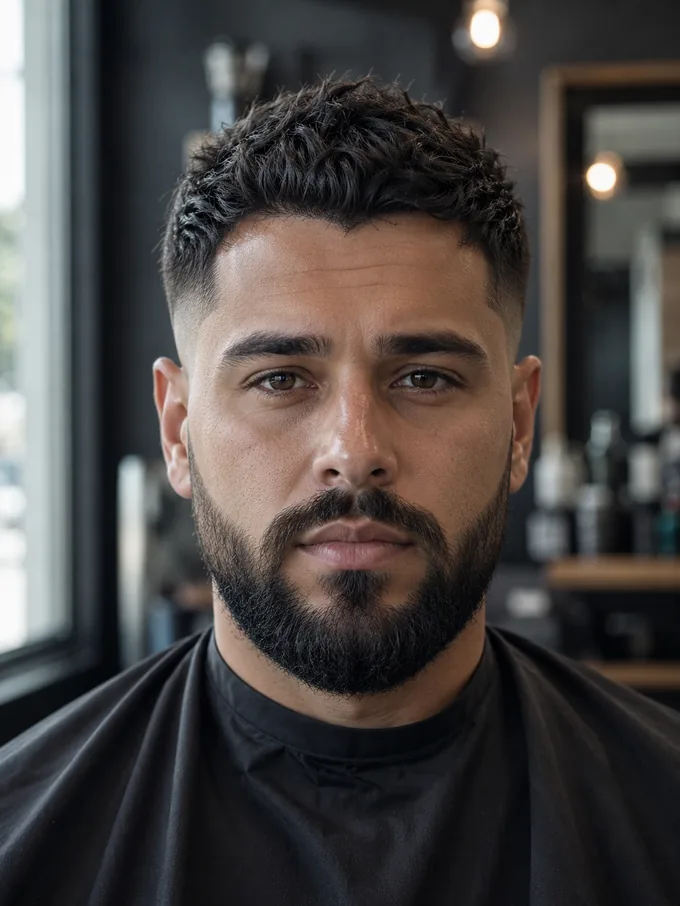
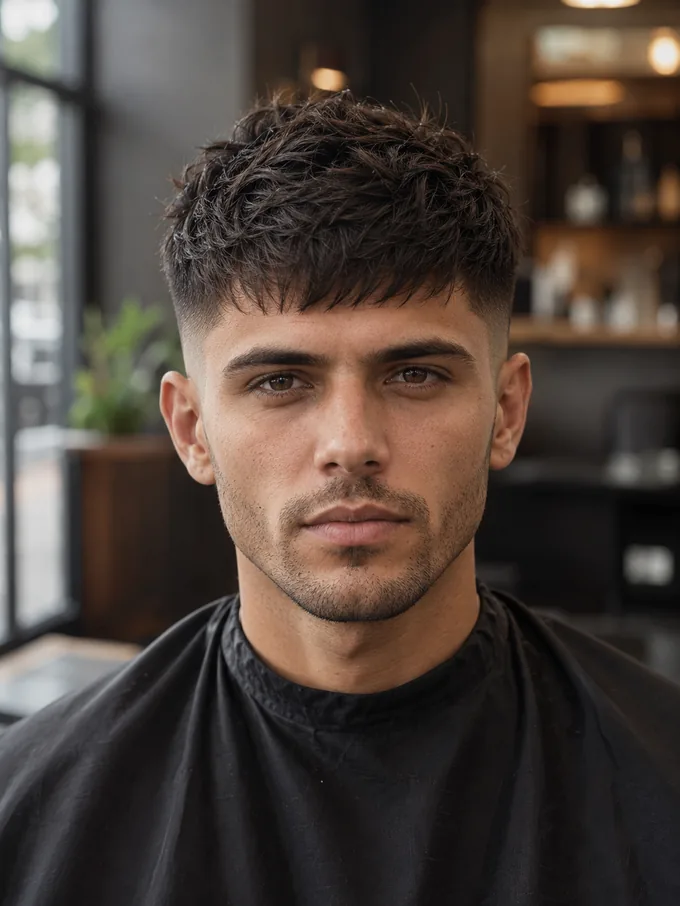
Mid drop fade heart face gallery

How to shape the beard
For a heart face, the beard isn't a finishing touch — it's the single most effective adjustment available. A haircut can only do so much about a narrow chin. Facial hair adds actual volume exactly where the proportion is short.
Build width through the jaw and chin, not the cheeks. Let the beard grow fuller along the jawline and squarer at the chin, which broadens the narrowest part of the face. Keep the cheek line tidy but don't take the sides in tight, or you lose the width you're trying to build.
Square off the bottom rather than rounding or pointing it. A beard trimmed to a point follows the direction your face already goes and exaggerates the taper. A flatter, squarer finish under the chin counteracts it.
Can't grow a full beard? Shaped stubble still helps. Even a chin strap or a fuller goatee adds visual mass low on the face, which is the goal. The beard pairing guide covers how the drop line connects into the beard fade.
What to avoid
- A high drop or high fade. Taking the fade up near the crown strips width from the sides and pushes all the visual weight to the top, which is already the widest part of the face.
- Pompadours and slicked-back styles. Both pull hair up and away from the forehead, exposing its full width. This is the most common heart-face mistake, and it's the exact style that works well on oval faces.
- A buzz cut with no beard. It exposes the forehead completely and adds nothing at the chin, so the taper reads harder. Buzz plus a full beard is a different story and works fine.
- A centre part. It splits the face symmetrically and draws a line straight down the middle of an already-tapering shape.
- Very tight, stripped sides. Some weight low on the head helps. Skin-close all around removes the only width available below the cheekbones.
- A beard trimmed to a point. It follows the taper instead of correcting it. Square the bottom off instead.
Common mistakes
Following generic "add height on top" advice. Plenty of face-shape guides repeat this for every shape because it suits round and square faces. On a heart face it backfires — height at the crown emphasises the forehead rather than balancing the chin.
Asking for a fade without specifying how low. "Mid drop fade" leaves the drop height to the barber, and the default is usually higher than a heart face wants. Say you'd like the drop kept lower and the sides not taken too tight. Our barber communication guide has the full wording.
Treating the beard as separate from the cut. On this face shape more than any other, the beard is doing the heavy lifting. Booking the cut and beard together lets the barber shape both around the same goal.
Growing the top out to cover the forehead completely. A heavy fringe pulled straight down hides the forehead but flattens the whole look and can make the chin appear narrower by contrast. Sweeping across works; curtaining down doesn't.
Myths vs facts
Myth: Volume on top balances out a narrow chin.
Fact: It does the opposite. Adding height widens the top of the face, which increases the gap between the broad forehead and the narrow chin rather than closing it.
Myth: A heart face should keep hair long to hide the forehead.
Fact: Length helps only when it's swept across. Hair pulled straight down over the forehead flattens the shape and draws attention to how narrow the lower face is.
Myth: A beard is optional styling.
Fact: For a heart face it's the most effective single change you can make. It adds mass at the jaw, which no haircut adjustment can replicate.
Myth: All face shapes want the same drop height on a mid drop fade.
Fact: The drop is one of the few adjustable parts of the cut. Round faces want it higher, heart faces want it lower, and oval faces can go either way.
Pros and cons for heart faces
Pros
- The drop is adjustable, so the same cut can be tuned lower for this shape
- Prominent cheekbones give the cut strong structure to work with
- Pairs exceptionally well with a beard, which does most of the balancing
- Low-maintenance styling, since the top isn't being lifted or held in place
Cons
- Most popular fade styles — pompadours, high fades — are the wrong direction here
- Needs a specific brief, since barbers default to a higher drop
- Works noticeably better with facial hair than without
- Generic face-shape advice online is often actively unhelpful for this shape
Is this the right version for you?
Good fit if: your forehead is the widest part of your face, you can grow at least shaped stubble, and you're happy with a moderate top worn forward rather than lifted.
Reconsider if: you specifically want a tall, structured style like a pompadour — that's fighting the shape, and a more balanced face shape carries it better.
Not sure of your shape? Check the widths again above, or try the fade finder quiz.